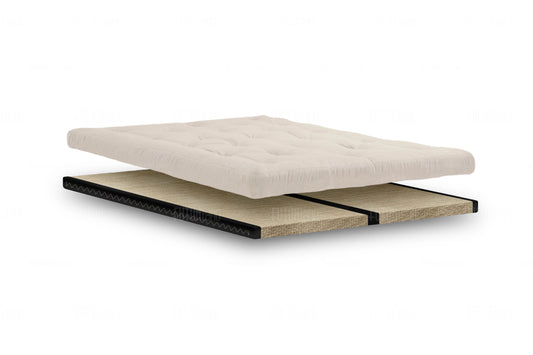

Twin vs Twin XL: Is a Twin XL Just a Longer Twin?
Twin vs Twin XL comes down to a single measurement. Both mattresses are the same width, 39 inches on our size chart and 38 inches at some other makers, but a standard Twin is 75 inches long and a Twin XL is 80. So yes, a Twin XL is a longer Twin, and nothing else about the sleeping surface changes.
Those 5 inches still decide more than legroom. They decide which sheets fit, which frame the mattress can sit on, whether the bed clears a tight stairway, and whether a bed bought for a 12-year-old still fits the same person at 17. This guide covers when the extra length is worth having for a growing teen and what changes once you choose it. Our Twin and Twin XL storage beds for kids, teens and dorms are built in both lengths on the same 40.5-inch-wide frame, so the choice there comes down to length alone.

Twin vs Twin XL dimensions
The table below uses the dimensions from our mattress size chart. Bed frames run a little larger than the mattress, usually by a few inches in each direction depending on the design.
| Twin | Twin XL | |
|---|---|---|
| Mattress width | 39 in (38 in at some makers) | 39 in (38 in at some makers) |
| Mattress length | 75 in (6 ft 3 in) | 80 in (6 ft 8 in) |
| Sleeping surface | About 20.3 sq ft | About 21.7 sq ft |
| Fitted sheets | Twin only | Twin XL only |
| Comforters and blankets | Often sold as Twin/Twin XL | Often sold as Twin/Twin XL |
| Common uses | Kids' rooms, bunk beds, daybeds, trundles | Teen rooms, college residence halls, guest rooms for tall adults |
Two details in that table matter more than they look. First, 80 inches is the same length as a Queen and a King, so a Twin XL is the only single-sleeper size that gives an adult-length bed. A Full, which many families treat as the step up from a Twin, is still 75 inches long. Second, the width does not change at all. A Twin XL is no roomier side to side, so it solves a length problem and nothing else.
When the extra 5 inches matter
The common rule of thumb is that a standard Twin starts to feel short once a sleeper passes about 6 feet, and a Twin XL takes over from there. The cutoff sits below 75 inches because nobody sleeps in a space exactly their own height. The pillow sits above the head and takes several inches of the mattress, and on the back or stomach the feet point downward and add a little more. A 6-foot teen on a 75-inch mattress has 3 inches of margin on paper and usually less in practice.
Height today is only half of it, because teens are not done growing. According to Nemours KidsHealth, girls usually reach adult height by about 14 or 15, while boys grow fastest between roughly 12 and 15 and most have stopped by 16. That gives a practical way to read the decision.
A teen who has finished growing. Buy for their current height. A 15-year-old who is 5 feet 6 inches and has stopped growing will be comfortable on a standard Twin for years.
A teen who is mid-growth. Buy for the height they are heading toward, not the height they are at. A 13-year-old boy who is already 5 feet 8 inches may well pass 6 feet before the bed is two years old. Parents' heights are a rough guide to where a child will land.
A child under 12. A standard Twin fits for years. If you expect the same frame to last through high school and the family runs tall, the Twin XL is the version that will not need replacing when the growth spurt arrives.
Signs a Twin is already too short
Teens rarely say a bed is too short. They adapt, and the adaptations are visible: feet hanging off the end in the morning, a habit of sleeping diagonally, the pillow jammed against the headboard, or sleeping curled up when they used to sleep stretched out. A footboard makes the problem obvious sooner, because the feet hit wood instead of hanging into air.
A two-minute length test
Have your teen lie on the floor in their usual sleeping position with their own pillow. Measure from the top edge of the pillow to the tips of the toes. If the result is within about 3 inches of 75, a Twin will be tight now or soon, and a Twin XL is the safer choice. If there is a hand's width or more to spare and growth is mostly done, a standard Twin is fine.
-
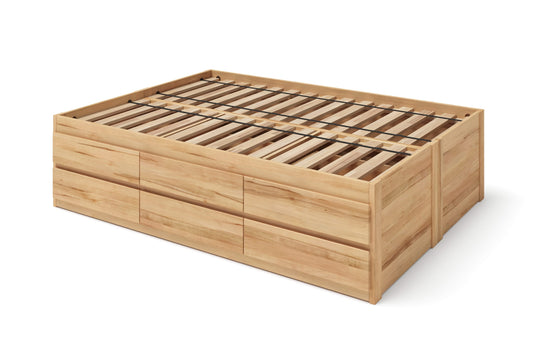
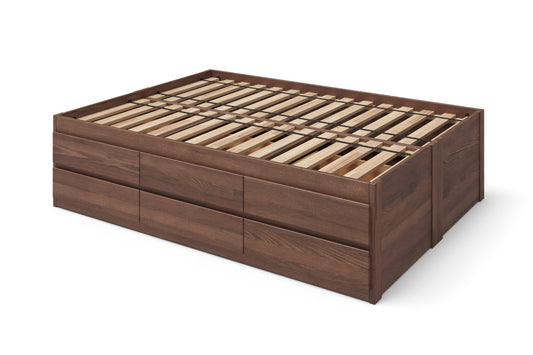 Sale
Captain's Bed
Regular price From $719.99Regular price $899.99 Sale price From $719.99Sale -
Afton Platform Bed
Regular price From $1,049.00Regular price Sale price From $1,049.00 -
Heartwood Shaker High Footboard Bed
Regular price From $3,013.00Regular price Sale price From $3,013.00 -
Modern American Trellis Low Footboard Bed
Regular price From $3,176.00Regular price Sale price From $3,176.00 -
Heartwood Shaker Studio-Style Platform Bed
Regular price From $1,454.00Regular price Sale price From $1,454.00 -
Contemporary Craftsman Studio-Style Platform Bed
Regular price From $1,454.00Regular price Sale price From $1,454.00 -
Modern American Trellis Bed
Regular price From $3,588.00Regular price Sale price From $3,588.00 -
Contemporary Craftsman High Footboard Bed
Regular price From $3,452.00Regular price Sale price From $3,452.00 -
Modern American Platform Bed
Regular price From $1,923.00Regular price Sale price From $1,923.00 -
Heartwood Shaker Low Footboard Bed
Regular price From $2,725.00Regular price Sale price From $2,725.00 -
Kipling Bed
Regular price From $1,923.00Regular price Sale price From $1,923.00 -
Contemporary Craftsman Low Footboard Bed
Regular price From $3,240.00Regular price Sale price From $3,240.00


Sheets: the part that catches people out
Because the width is identical, it is easy to assume the bedding is interchangeable. Some of it is. Flat sheets, blankets, duvets and comforters usually cross over, which is why so many are labeled Twin/Twin XL. Fitted sheets and mattress protectors do not.
A Twin fitted sheet is cut for a 75-inch mattress and will not stay on an 80-inch one; a corner pops off overnight. A Twin XL fitted sheet on a standard Twin leaves 5 inches of slack that bunches under the sleeper. The same applies to fitted mattress protectors and encasements. If you switch sizes, the fitted layer has to be replaced.
Check pocket depth while you are at it. Fitted sheets are cut for a range of mattress thicknesses, and a deep-pocket sheet on a thin mattress shifts and wrinkles. A 4-inch futon mattress and a 12-inch innerspring need different sheets even when both are Twin XL.
Frames: the mattress and the base have to match
A platform bed or captain's bed has a fixed deck of slats, and the mattress needs to cover it edge to edge. A Twin mattress on a Twin XL frame leaves a 5-inch strip of bare slats at one end, where pillows fall through and the mattress slides. A Twin XL mattress on a Twin frame overhangs by 5 inches with nothing under it, and that unsupported edge will sag.
That makes the frame the real commitment. A solid wood frame usually outlasts more than one mattress, so the length you choose at the frame stage decides the bed for years. If a Twin XL is likely to be needed in two or three years, buying the longer frame now avoids replacing the whole bed later.
Room size and delivery
Five inches rarely changes whether a bed fits a bedroom, but it can change what fits around it. Measure the wall the bed will run along and check door swings and closet doors near the foot of the bed. A bed that ends 5 inches closer to a closet can turn a sliding door into a tight squeeze.
The less obvious constraint is getting the frame into the room. Our Twin XL storage beds ship assembled, and assembled they measure about 82 by 40.5 inches. In a straight hallway that length rarely matters; a stairway that turns at a landing, or a low ceiling at the top of the stairs, is where an 82-inch piece gets stuck. Measure the tightest turn before ordering. Flat-pack shipping is available on request for exactly this case, with assembly taking three to four hours.

Twin XL and college
Twin XL is the mattress size most college residence halls use, though some schools use standard Twin or Full, so check the housing office's room specifications before buying bedding. For families with a teen two or three years from college, that creates a useful overlap. Fitted sheets, a mattress protector and a topper bought for a Twin XL bed at home also fit the dorm mattress, and anything bought for the dorm comes home and works on breaks.
The bed itself also has a life after high school. A Twin XL makes a guest bed that fits tall adults, which a standard Twin does not. And two Twin XL mattresses side by side cover roughly the footprint of a King, which is how split-King setups are built. Our King captain's bed is made the same way, from two Twin XL sections joined side by side.
When a standard Twin is the better choice
The Twin XL is not automatically the upgrade. A standard Twin makes more sense when the sleeper has finished growing and fits comfortably within 75 inches, when the bed needs to work with a trundle, daybed or bunk bed built for Twin mattresses, or when the family already owns good Twin bedding for several children. It is also the right call in a room so tight that 5 inches decides whether a door or drawer can open.
If the real complaint is space to spread out rather than length, neither size is the answer. A Full adds 15 inches of width but no length at all, which is a different trade for a teen.
Frequently Asked Questions
How long is a Twin XL bed?
A Twin XL mattress is 80 inches long, or 6 feet 8 inches, which is 5 inches longer than a standard Twin at 75 inches. The width is the same, 38 to 39 inches depending on the maker. The frame adds a little more; our Twin XL storage beds measure about 82 inches long assembled. Use the frame dimensions, not the mattress, when measuring a room.
Do Twin sheets fit a Twin XL mattress?
Fitted Twin sheets do not. They are cut 5 inches short and will pull off a corner overnight. Flat sheets, blankets and comforters usually work on both sizes, and many are sold as Twin/Twin XL. Fitted mattress protectors follow the same rule as fitted sheets, so they need to match the mattress length. It also helps to match the sheet's pocket depth to the mattress thickness.
How tall does someone need to be for a Twin XL?
The usual rule of thumb is that a sleeper around 6 feet or taller is better served by a Twin XL, because the pillow and pointed feet take up several inches of a 75-inch mattress. For a teen who is still growing, decide by the height they are likely to reach rather than their current height. Boys in particular often keep growing until about 16.
Can you put a Twin mattress on a Twin XL frame?
You can, but it leaves 5 inches of bare slats at one end. Pillows slip into the gap and the mattress tends to slide toward it. The reverse is worse: a Twin XL mattress on a Twin frame hangs 5 inches past its support, and that edge sags over time. Match the mattress length to the frame whenever possible, and treat the frame as the long-term decision.
Do two Twin XL beds make a King?
Two Twin XL mattresses side by side cover roughly the same area as a King, which is 76 by 80 inches, and that is how split-King beds are made. Two separate Twin XL frames pushed together are a different matter, since the frame edges leave a ridge and a gap down the middle. A King frame built from two joined Twin XL sections avoids that problem.
A Twin XL really is just a longer Twin, and that is the whole case for it: the same width and nearly the same floor space, with an adult-length bed for a teen who is about to need one. Choose by the height your teen is heading toward, match the fitted sheets and mattress to the frame, and measure the stairs before delivery. If your teen needs room to spread out rather than room to stretch, our guide to Twin XL vs Full for a teenager covers the width side of the decision, and Bunk Beds for Teens: What Still Works as Kids Get Older covers rooms that siblings share.