
Bunk Beds for Teens: What Still Works as Kids Get Older
Bunk beds are typically marketed at young children. The photography shows six-year-olds. The copy talks about playtime and adventure. None of which helps the parent of a thirteen-year-old who needs two sleeping surfaces in one room and wants something that will still look reasonable in four years.
Teenagers have different requirements from young children, and most bunk beds on the market don't address them well. The issues are concrete: weight capacity, sleeping surface size, aesthetic that doesn't signal childhood, and structural durability for occupants who are larger and harder on furniture than they were at eight. Comfort Pure's solid wood bunk beds were designed for longevity rather than a specific age group, and several models suit teenagers and young adults as well as they suit children.

Weight Capacity: The Practical Starting Point
Most bunk beds list a weight limit per bunk. The numbers that appear on cheaper frames — 150 to 175 pounds per bunk — are often marginal for teenagers, and become inadequate for older adolescents or adults. A fifteen-year-old who weighs 160 pounds and has a friend sleep over on the bottom bunk is already at or beyond the rated capacity of many frames on the market.
Solid hardwood construction — pine and rubberwood in the Comfort Pure lineup — holds weight more reliably than frames built from MDF, particleboard, or steel tubes with welded joints that can fatigue over time. Mortise and Tenon joinery, used throughout the rubberwood models, doesn't loosen the way screwed-and-doweled assemblies do under repeated load. For teenagers who are approaching adult weight, the construction method is more meaningful than the stated weight limit alone.
Sleeping Surface Size
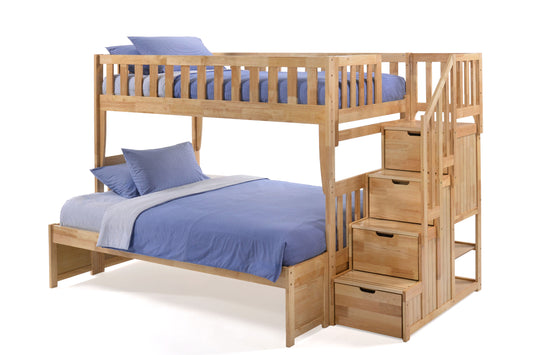
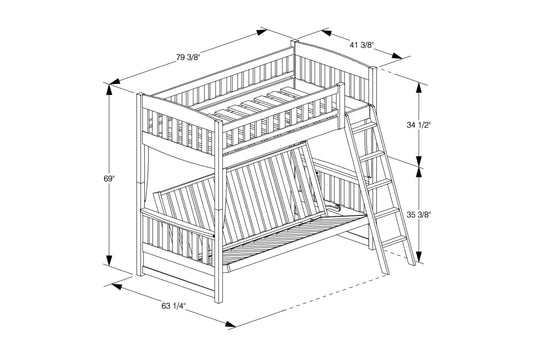
A twin-size upper bunk — 38 by 75 inches — is adequate for most teenagers who aren't particularly tall. A full-size lower bunk, available in the twin/full configuration across multiple Comfort Pure models, is considerably more comfortable for a larger child or teenager and becomes a genuinely adult-appropriate sleeping surface.
If both occupants are teenagers or if one is close to full adult height, the twin/full configuration is the more practical choice. The full lower bunk has 16 additional inches of width compared to a twin — enough to sleep comfortably rather than just adequately. All twin/twin models also offer the conversion kit option, so a bunk bed purchased for two younger children doesn't have to stay twin/twin as they grow.
-
Peppermint Solid Wood Bunk Bed with Storage Stairs
Regular price From $1,949.99Regular price Sale price From $1,949.99 -
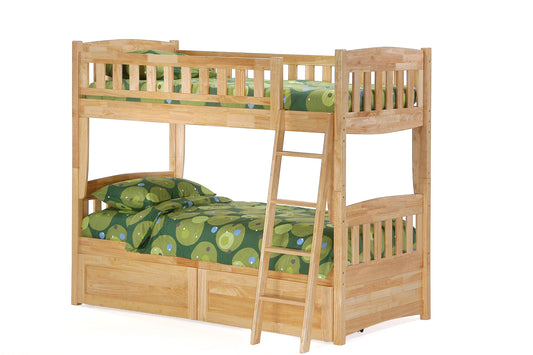
Cinnamon Solid Wood Bunk Bed
Regular price From $1,279.99Regular price Sale price From $1,279.99 -
Cinnamon Solid Wood Futon Bunk Bed
Regular price From $1,629.00Regular price Sale price From $1,629.00 -
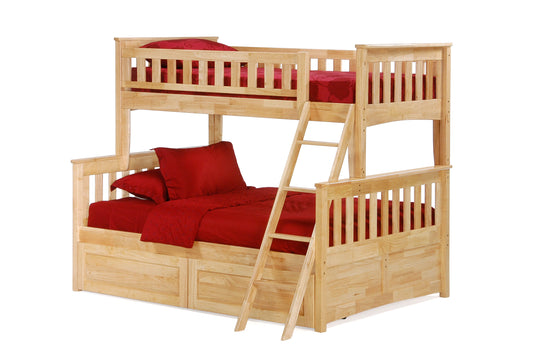
Ginger Solid Wood Bunk Bed
Regular price From $1,689.99Regular price Sale price From $1,689.99 -
Phoenix Solid Pine Bunk Bed
Regular price From $669.99Regular price Sale price From $669.99 -
Sacramento Solid Pine Bunk Bed
Regular price From $819.99Regular price Sale price From $819.99 -
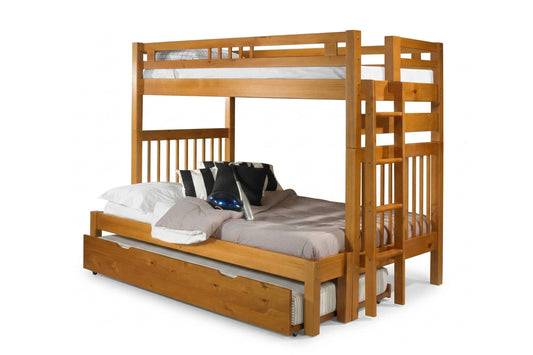
Sacramento Solid Pine Bunk Bed with Storage Stairs
Regular price From $1,349.99Regular price Sale price From $1,349.99







Style That Ages With the Room
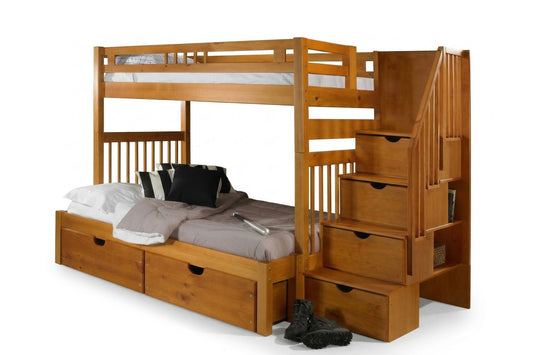
The rubberwood models — Cinnamon, Ginger, and Peppermint — have design lines that work in a teenager's room without looking like children's furniture. The Cinnamon's arched headboard styling is traditional without being juvenile. The Ginger, available in full/full, has a slightly more substantial visual presence appropriate to its larger size. The Peppermint's staircase design is functional rather than decorative, and the overall profile reads as furniture rather than play equipment.
This matters for teenagers who have genuine opinions about their rooms and are resistant to sleeping in something that looks like it belongs in a nursery. The natural rubberwood finish — a warm, light tone — pairs with the kind of bedroom furniture that teenagers typically choose as they start personalizing their space.
Durability Over the Teen Years
Teenagers are harder on beds than young children in different ways. Young children jump and climb. Teenagers sit on the edge heavily, use the frame as a backrest, and sleep in positions that put sustained lateral pressure on the frame. A frame that felt sturdy at assembly but wasn't built with genuine joinery integrity may develop wobble within a few years of this kind of use.
The Mortise and Tenon construction on Comfort Pure rubberwood models addresses this by making the joint itself the structural element rather than the hardware holding the joint together. It's the same construction principle used in furniture designed to last decades, and it translates to a bunk bed that stays solid through the teenage years rather than becoming increasingly unstable as the hardware loosens.

When to Consider a Separate Bed Instead
A bunk bed isn't always the right answer for teenagers. If both occupants want genuine privacy, if the room is large enough to accommodate two separate beds, or if both teenagers are at or near adult height and want full-size sleeping surfaces, a platform bed or separate frame may serve them better. The bunk bed makes most sense when the room genuinely constrains the options, when the two occupants have a reasonably cooperative relationship, or when the sleeping situation is temporary — a college-bound sibling, a guest situation, a home that will change configuration in a few years.
FAQs
What weight capacity should a bunk bed have for teenagers?
Look for frames rated at 200 pounds or more per bunk, and pay attention to construction method alongside the stated number. Solid hardwood frames with quality joinery hold weight more reliably over time than lighter frames.
Is a twin bunk bed appropriate for a teenager?
A twin upper bunk works for most teenagers who aren't particularly tall. For the lower bunk, a full-size sleeping surface is noticeably more comfortable for teenagers and remains appropriate into adulthood.
Which Comfort Pure bunk bed models suit teenagers best?
The Cinnamon, Ginger, and Peppermint rubberwood models — with their traditional design lines, solid construction, and available twin/full and full/full configurations — are the most appropriate for older children and teenagers.
Can the twin/twin models be upgraded to twin/full as children grow?
Yes. All twin/twin models include conversion kit compatibility, allowing the bottom bunk to be upgraded to a full sleeping surface without replacing the frame.
Do bunk beds genuinely work for teenagers, or is it better to get separate beds?
Bunk beds work well for teenagers when the room constrains the options or when the sleeping arrangement is expected to change in a few years. For teenagers who want privacy or who are close to full adult height, separate platform beds are often the more comfortable long-term choice.
A bunk bed bought for teenagers doesn't need to look like children's furniture or be replaced in three years. The rubberwood models in the Comfort Pure lineup were built with enough structural integrity and enough visual neutrality to work through the teenage years — and, in the right context, beyond them.
For more on what makes solid wood construction worth the investment over time, the article on why solid wood matters for a bunk bed covers the material and joinery decisions behind these frames in detail.