
Best Non Toxic Bed Frame: How to Verify One Before You Buy
Check the panel type, adhesive, and finish before buying any bed frame. Solid wood doesn't automatically mean non-toxic, because a conventional lacquer, hidden plywood, or glue-heavy joint can still affect emissions.
The phrase “non-toxic bed frame” sounds precise, but furniture labels rarely make it so. A better approach is to inspect the frame as a material system. Ask what the visible structure is made from, what holds it together, and what coats the surface. Then check whether an independent certification supports the answer.
That method matters because furniture can contribute formaldehyde and other volatile organic compounds to indoor air. The U.S. Environmental Protection Agency's wood-furniture manufacturing guidance notes that individual furniture facilities can emit more than 23 megagrams per year, or 25 tons per year, of organic hazardous air pollutants, including formaldehyde. Research on bedroom furniture also found that most products released at low rates, while some exceptions produced bedroom concentrations above health guidance, particularly when furniture had a large surface area in a small room. The Danish Environmental Protection Agency's furniture research explains why the room and the finished product both matter.
This guide gives you a repeatable way to evaluate the best non toxic bed frame for your home, whether you're shopping for a nursery, an apartment, or a bedroom where material transparency matters more than decorative features.
Why Solid Wood Alone Does Not Make a Bed Frame Non Toxic
Solid wood is a strong starting point, not a complete answer. The timber itself usually isn't the main concern. Emissions more often come from engineered panels, adhesive lines, and surface coatings added during construction.
A bed marketed as solid wood may still contain a plywood drawer bottom, an MDF headboard insert, particleboard storage panels, or glued slats. It may also use a solvent-heavy lacquer. The wood species, whether cherry, maple, oak, or walnut, doesn't tell you enough about those components.
The solid wood bed collection can help you compare designs, but you should still read the individual material specifications. Product categories are useful for narrowing the search. They aren't a substitute for construction details.
Use a three-point verification lens
Start with the panel type. Solid wood consists of boards cut from timber. Plywood consists of thin wood veneers bonded in layers. MDF uses compressed wood fibers, while particleboard uses wood particles and resin. These materials can be useful structurally, but their emissions profile depends heavily on the binder and the finished product.
Next, identify the adhesive. Urea-formaldehyde resins are a well-known source of formaldehyde in veneered and laminated wood products. Glue may sit inside a panel, under a veneer, between slat layers, or at a corner block where you can't see it.
Finally, identify the finish. Lacquer, stain, polyurethane, hardwax oil, and water-based coatings all behave differently during curing and use. A solid hardwood frame with a conventional lacquer can release more solvents than a plywood frame finished with a well-documented water-based coating.
Practical rule: Treat “solid wood” as one answer in a three-part test, not as the entire verdict.
FSC certification doesn't change this rule. FSC addresses responsible forestry and chain of custody. An FSC-certified solid wood bed can still fail your emissions preference if its finish or adhesive is undisclosed. Conversely, a frame with a composite component may deserve further consideration if the component has credible emissions documentation.
What Non Toxic Means in Furniture
“Non-toxic” is an unregulated marketing phrase in furniture. A manufacturer can use it without showing that the finished bed passed a specific emissions test. Treat the label as a starting point, not evidence.
Use a verification method based on three questions: what panels are present, which adhesives hold them together, and what finish covers them. The wood species matters for durability and appearance, but it does not answer the emissions question by itself.
In the United States, composite-wood bed frames and finished furniture are subject to TSCA Title VI and CARB Phase 2 formaldehyde emissions limits. The EPA's formaldehyde standards for composite wood products explains the federal requirements and their relationship to California rules.
CARB Phase 2 compliance is meaningful when a bed contains composite wood. Finished-goods testing uses ASTM D6007 small-chamber methods, examining the emission profile of the finished product rather than only its visible surface. The rule remains limited, though. It addresses formaldehyde emissions from regulated composite-wood components, not every finish solvent, flame retardant, fabric treatment, or metal coating.
A CARB-compliant frame can still use a finish you do not want in a bedroom. It can also include upholstery, foam, or adhesives outside the panel rule's scope. Read the compliance statement as one documented answer, not as a complete verdict on the entire bed.

Certifications are more useful than slogans
GREENGUARD Gold is a voluntary indoor-air emissions certification administered by UL. It evaluates finished products against emissions criteria covering volatile organic compounds, including formaldehyde. Its stricter limits make it more informative for a complete frame than a material slogan, but check the certificate's scope. It may cover the bed frame without covering a separately sold headboard, mattress, bedding item, or replacement slat kit.
The Heartwood Shaker Studio-Style Platform Bed is described as handcrafted in Vermont from solid cherry, maple, or walnut, with an eco-friendly oil finish, mortise and tenon joinery, solid poplar slats, and center support on sizes other than twin. Those details clarify its construction. Certification documentation would address emissions more directly.
For material comparisons, browse the non-toxic furniture collection, then verify each product page's panels, adhesives, finish, and certification scope.
Where Emissions Come From in a Bed Frame
A bed frame's wood species tells you less than its panel chemistry, adhesive, and finish. Inspect each component, especially in storage beds and upholstered designs, where hidden materials can dominate the emissions profile.
Engineered panels deserve the first check. MDF, particleboard, and some plywood use binders that can release formaldehyde. Concern rises with extensive panel surface area, including drawer systems, thick headboard cores, and enclosed slat cassettes. A PubMed-indexed indoor-air study of furniture emissions found formaldehyde increments from some beds above the 100 µg/m³ guideline value, while TVOC increments exceeded 400 µg/m³ in multiple cases. The research also connects emissions from wood-based products with adhesive chemistry, particularly urea-formaldehyde resins.
A solid hardwood exterior does not settle the question. Laminated rails, plywood slats, dowel joints, corner blocks, and veneer can all contain glue. Mechanical joinery can reduce dependence on large glued surfaces, but evaluate the actual construction and product documentation rather than assuming the joinery eliminates adhesives.
Finishes create another emissions pathway. Lacquer and solvent-heavy polyurethane can release VOCs while curing. Water-based coatings generally use a different solvent system. Oils and waxes may have simpler formulations, but they still need product-specific disclosure.
Upholstery introduces foam, fabric, batting, flame-retardant strategies, adhesives, and sometimes stain-resistant treatments. Metal avoids wood-panel resins, yet powder coating, plating, and other surface treatments still vary.
For a plain-language overview of why people research off gassing health effects, use that background as context, then return to product-specific emissions evidence. Material and certification documents provide a stronger buying basis than a broad “clean air” claim.
Bed Frame Component Emission Risk
| Component | Typical risk level | Most common fix |
|---|---|---|
| MDF or particleboard | Higher concern because resin binders are integral to the panel | Choose solid wood or request TSCA Title VI and CARB Phase 2 documentation |
| Plywood | Variable, depending on resin, layers, edge exposure, and finish | Ask for the plywood grade and formaldehyde or no-added-formaldehyde adhesive details |
| Adhesive | Variable to high when large glued surfaces use formaldehyde-based resin | Favor mechanical joinery and disclosed low-emission or formaldehyde-free adhesive |
| Conventional lacquer or solvent-heavy coating | Variable during curing | Choose a named low-VOC water-based finish or clearly documented oil or wax |
| Upholstery and foam | Multiple unknowns can be present | Choose an unupholstered frame or request component-level documentation |
| Powder-coated or plated metal | Usually avoids engineered-wood resin, but coating chemistry varies | Ask what coating is used and whether the finished frame has emissions testing |
| Solid hardwood | Usually lower material concern, but finish and hidden parts still matter | Verify the coating, slats, adhesives, and any concealed panels |
Components Risks and Certifications at a Glance
A bed frame earns a low-emission assessment component by component. No single certification covers every part of a bed frame. FSC addresses forestry and responsible sourcing. GREENGUARD Gold addresses finished-product emissions. GOTS and GOLS apply to specific organic textile and latex components, not automatically to the whole frame.
| Component | Typical emissions risk | Certifications to look for | Repairable? |
|---|---|---|---|
| Solid wood | Usually lower from the wood itself, while finish, adhesive, and concealed parts still matter | GREENGUARD Gold for finished emissions, FSC for responsible sourcing | Usually yes, especially with accessible joinery |
| Plywood | Varies with resin, veneer layers, exposed edges, and coating | TSCA Title VI or CARB Phase 2 for regulated composite wood, GREENGUARD Gold for the finished product | Sometimes, depending on delamination or damage |
| MDF | Resin binder is integral to the panel | TSCA Title VI or CARB Phase 2, plus GREENGUARD Gold where available | Limited, especially after swelling or edge damage |
| Particleboard | Resin binder and vulnerable edges create a variable profile | TSCA Title VI or CARB Phase 2, plus finished-product emissions documentation | Limited |
| Metal | Avoids wood-panel resin, but coating or plating chemistry varies | GREENGUARD Gold for the finished frame, if available | Often, with replaceable hardware and refinishing options |
| Upholstery | Foam, fabric, adhesive, and treatments introduce several unknowns | GREENGUARD Gold for the complete product, GOTS for organic textile, GOLS for latex, OEKO-TEX for tested textile components | Fabric and foam replacement can be difficult |
| Adhesive | Chemistry strongly affects the emissions profile | Product-level emissions certification, plus explicit formaldehyde-free or no-added-formaldehyde documentation | Usually difficult once bonded |
| Finish | Solvent and curing chemistry vary widely | GREENGUARD Gold for finished emissions, with named finish ingredients or type | Oil and wax are easier to renew than hard films |
FSC can help verify responsibly sourced wood. The FSC-certified furniture collection is a useful starting point, but FSC does not certify low emissions. Pair it with information about the panels, adhesives, finish, and finished-product testing.
Finish ranking and trade-offs
For practical emissions screening, use this order:
- Pure hardwax oil
- Natural linseed or tung oil and wax
- Low-VOC, water-based polyurethane
- Conventional oil-based polyurethane
- High-gloss conversion varnish
This ranking is qualitative, not a universal test result. Formulas differ, and a product-specific emissions certificate carries more weight than a finish category alone.
Hardwax oils and natural oils are easier to repair because worn areas can be cleaned and renewed without stripping an entire film. Water-based polyurethane provides a tougher surface, though spot repairs may be more visible. Conventional lacquer and conversion varnish can produce durable finishes, but they are weaker choices when the maker will not identify the product or provide finished-product emissions testing.
Treat the table as a screening tool, not proof of safety. A solid hardwood frame with an undisclosed coating can leave more unanswered questions than a plywood frame with documented adhesive chemistry and finished-product testing. The verification standard is simple: identify every material, then check the panel chemistry, adhesive, finish, and certification scope.
How to Read Specs and Ask the Right Questions
A product page should identify the frame's materials without requiring a long email exchange. Look for exact terms such as solid hardwood, plywood, MDF, and particleboard. Phrases like “wood materials” and “wood composite” conceal the panel chemistry that determines much of the emissions risk.
The finish needs the same level of detail. “Eco finish” says nothing about whether the coating is oil, hardwax oil, water-based polyurethane, lacquer, or another formula. Ask whether it is water-based, whether the maker states a low-VOC specification, and whether a product data sheet is available.
Ask for these details
- Panel construction: Which parts use solid wood, plywood, MDF, or particleboard?
- Adhesive chemistry: Which adhesive bonds the plywood or laminated parts? Is it formaldehyde-free or no-added-formaldehyde?
- Finish: What exact finish is applied? Is it oil, hardwax oil, water-based polyurethane, lacquer, or another coating?
- Certification scope: Can the retailer provide the GREENGUARD Gold certificate number for the complete frame?
- Slats: Are they solid wood or plywood? What are their dimensions and spacing?
- Support: Does the design include a center rail or legs? What weight capacity does the manufacturer specify?
- Textiles: Does an upholstered section have GOTS or OEKO-TEX documentation? Does any latex component have GOLS documentation?
- Metal treatment: Is the steel powder-coated, plated, or treated another way?
Use direct questions in a retailer chat:
“Which adhesive bonds your plywood?”
“What type of finish is applied, and is it water-based or oil-based?”
“Can you send the GREENGUARD Gold certificate number and confirm which components it covers?”
A reply limited to “natural,” “green,” or “clean” is not a specification. Ask for the supporting document or exact material description. The richtlijn voor duurzaamheidsclaims helps distinguish a verifiable environmental statement from promotional wording.
Don't overlook the slats
Slats often introduce a separate verification issue. A frame may use solid hardwood for its rails but plywood for the slats. That is not automatically a poor choice, yet you still need to ask whether the slats are laminated, which resin bonds them, and whether their edges are sealed.
Check the spacing against the mattress manufacturer's requirements. Inspect the design for center supports and legs, particularly on larger sizes. A frame with clear material documentation still fails as a long-term purchase if it flexes, shifts, or damages the mattress.
Frame Types That Best Meet the Criteria
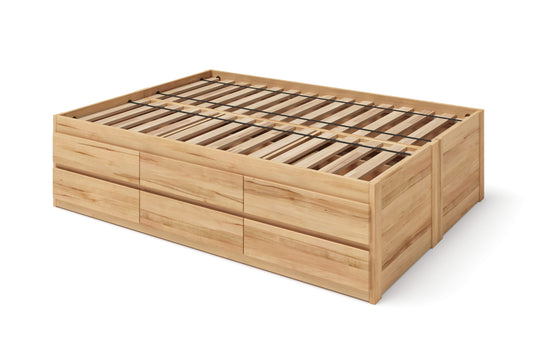
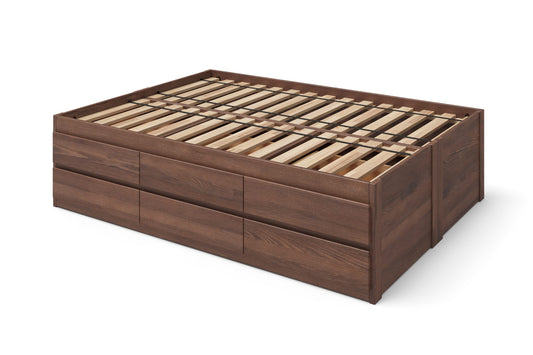
The solid hardwood platform is the clearest choice for most buyers. It can minimize engineered panels, expose the construction, and support mechanical joinery. It is usually heavier and more expensive than a panel-based frame, and solid hardwood can move with changes in room humidity. Choose it when long service life and repairability matter more than easy handling.
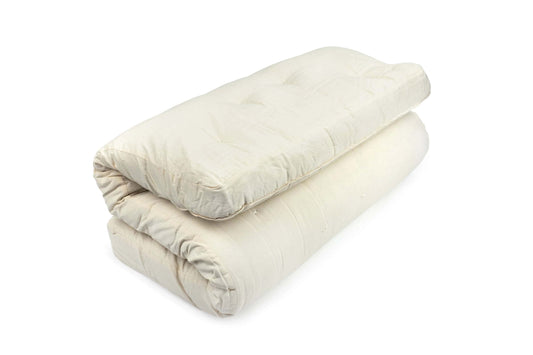
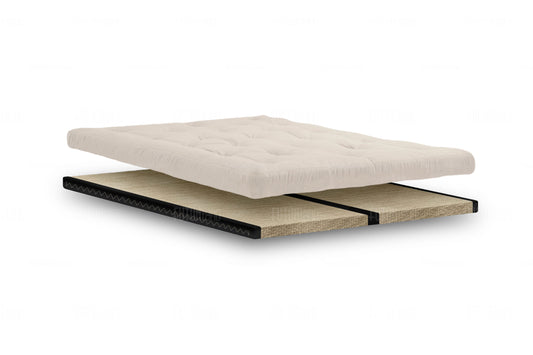
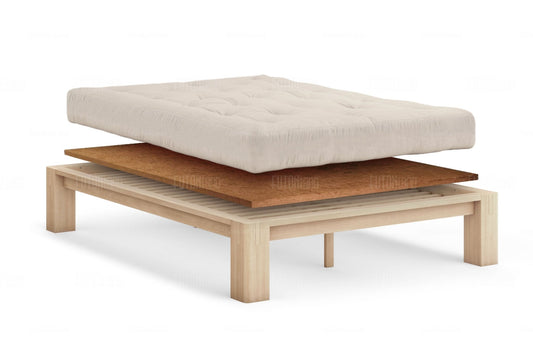
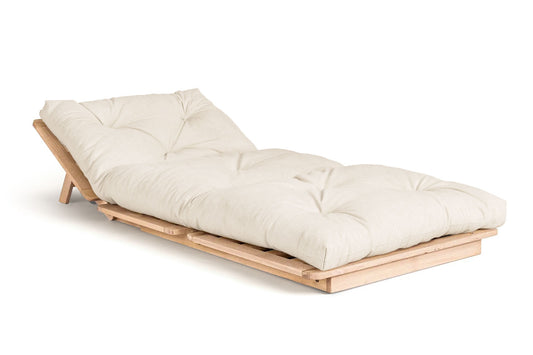
A tatami-style platform suits futons, compact rooms, and buyers who prefer a low visual profile. Its simple geometry can reduce upholstery and decorative paneling. The trade-off is practical: the mattress or futon needs appropriate breathability, and a low frame offers less under-bed storage. Explore tatami beds if that format matches your sleep system.
Floor beds remove much of the frame structure and work well in minimalist rooms or children's spaces. They can reduce the number of coated and glued components, but they also reduce airflow beneath the mattress and eliminate useful storage. A floor-level design demands careful attention to ventilation and moisture management. See the floor bed collection for this category.
An unfinished or hardwax-oil-finished frame offers the easiest visual verification. You can inspect the wood, avoid opaque coatings, and renew an oil finish as it wears. Unfinished wood needs more care and can mark more easily, while oil-finished wood requires periodic maintenance. For a nursery, choose the frame with the clearest material documentation rather than the one with the most elaborate styling.

Match the frame to the room
- Eco-conscious minimalists: Choose solid hardwood or an oil-finished platform with FSC documentation.
- Small-space dwellers: Consider tatami or a simple platform, then confirm mattress ventilation.
- Parents furnishing a nursery: Favor an unupholstered solid-wood design with plainly documented finishes and no hidden panels.
- Chemical-sensitive sleepers: Choose the frame with the fewest unknowns, not the most natural-sounding description.
A low price usually points to at least one trade-off. It may indicate imported engineered wood, undisclosed adhesive, veneer over particleboard, thin hardware, or an imported fabric without OEKO-TEX documentation. That doesn't prove poor performance, but it gives you a reason to ask more questions before ordering.
The Final Verdict and Your Pre-Purchase Checklist
A non toxic bed frame is not defined by its wood species. It is defined by what you can verify, frame by frame. Check the panel chemistry, adhesive, finish, slats, upholstery, and finished-product emissions. Solid wood simplifies the review, but it does not replace it.
Use this checklist before buying:
- Panel: Choose solid wood, or composite wood with documentation showing compliance with the relevant emissions standard.
- Adhesive: Require explicit disclosure. Look for formaldehyde-free or no-added-formaldehyde language where applicable.
- Finish: Identify the exact finish, such as hardwax oil, natural oil, or a low-VOC water-based coating.
- Slats: Confirm the material, spacing, dimensions, and support structure.
- Upholstery: Request details for the foam, textile, treatments, and applicable certifications.
- Certification: GREENGUARD Gold addresses finished-product emissions. FSC addresses forestry. GOTS applies to organic textiles, and GOLS applies to organic latex.
A certificate for one material does not prove that the whole bed is low-emitting. Prefer documentation for the complete finished product, especially when the frame combines panels, coatings, foam, and fabric.
After delivery, ventilate the room and follow the manufacturer's curing guidance. Do not rely on a universal airing-out period. A persistent smell warrants continued ventilation and a question to the maker. Odor alone does not establish a chemical concentration or provide a reliable deadline.

FAQ
Is solid wood always non-toxic?
No. Solid wood removes one major concern, engineered-panel resin, while leaving the finish, adhesive, slats, and upholstery to verify.
Does MDF off-gas forever?
MDF emissions change over time and depend on the resin, surface finish, temperature, humidity, and ventilation. They do not vanish immediately, and they do not stay constant forever. Product-level testing gives better evidence.
Are plywood slats a problem?
Not automatically. Ask which resin bonds the layers, whether the slats are certified, and whether their edges are sealed. Solid slats are easier to assess.
What finish is safest?
No finish is safest in every application. Hardwax oil and natural oils offer a simple, repairable surface. A documented low-VOC water-based finish can also work well. Finished-product testing matters more than the finish name alone.
Do you need GREENGUARD Gold?
Not for every frame. It becomes more useful when the design includes composite panels, upholstery, or several coatings because it evaluates finished-product emissions.
How long should a new frame air out?
Follow the manufacturer's curing instructions and ventilate the room. If solvent odor remains, continue airing it out and ask for the finish's cure and emissions information.
Are metal frames non-toxic?
Metal frames avoid MDF and particleboard resins, but powder coating, plating, adhesives, and packaging still vary. Ask about the coating and seek finished-product emissions documentation.
For the full sleep setup, use the non-toxic mattress guide, then compare construction details across the other guides and collections.
Before ordering, send the retailer this checklist and request the panel, adhesive, finish, slat, and certification details in writing. Incomplete answers are a reason to choose a simpler frame with fewer unknowns, not a reason to accept a natural-sounding label.