
Dunlop vs Talalay Latex in a Futon Mattress: Which One Actually Fits the Job?
If you're choosing a natural futon mattress and you've hit the Dunlop vs Talalay question, you're already asking the right thing — but probably in the wrong order. Most of the available guidance is written for standard mattress shoppers. A futon is a different product with a different job, and which latex process fits best depends on that job more than on general feel preferences.
The short version: both Dunlop and Talalay are natural latex manufacturing processes that start from the same material — rubber tree sap — and produce foams with distinct characters. Dunlop is denser, firmer, and typically less expensive. Talalay is lighter, softer, and more airy. For most futon builds, Dunlop is the more practical choice. But getting there requires understanding what each process actually does and why the futon context changes the calculation.

What Latex Is Doing Inside a Futon
Natural latex in a mattress starts as liquid sap tapped from Hevea brasiliensis rubber trees. That sap is whipped into a froth, poured into a mold, and either baked (Dunlop) or vacuum-expanded, frozen, and then baked (Talalay). The result is an open-cell foam that responds instantly to pressure — completely unlike memory foam, which deforms slowly and holds an impression. Latex pushes back. It recovers the moment weight is removed.
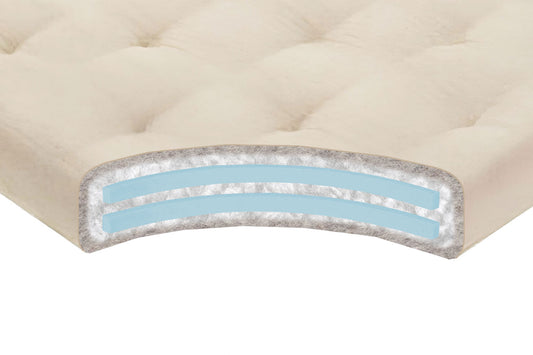
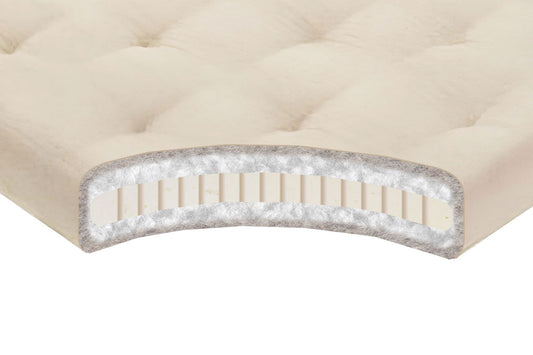
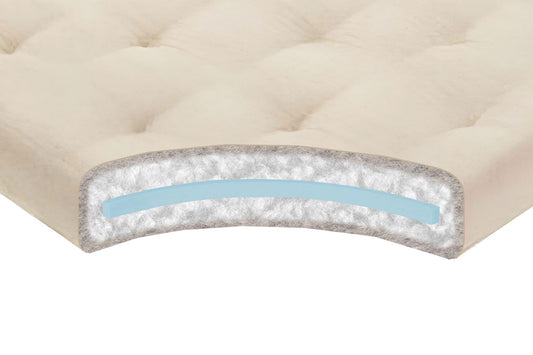
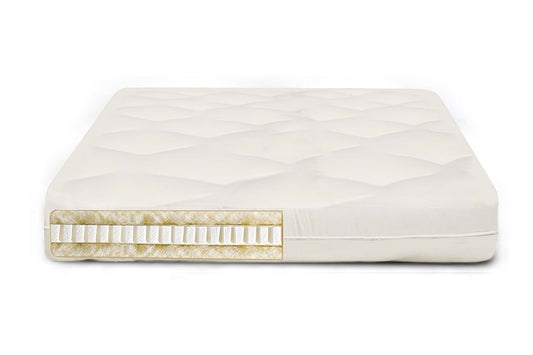
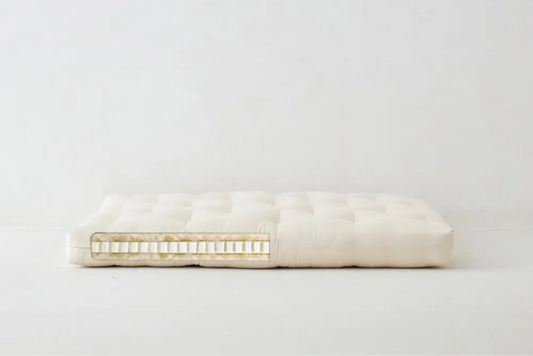
In a futon, latex plays a supporting role alongside cotton and wool rather than making up the whole mattress. A typical latex-enhanced futon build layers cotton for body, wool for climate regulation and resilience, and latex for pushback and long-term shape retention. The latex layer is what keeps a futon from developing the packed-down, permanently compressed feel that plain fiber builds sometimes develop with regular use.
That context matters for the Dunlop vs Talalay question. In a standard mattress, manufacturers often use both — Dunlop for the support core, Talalay for a plush comfort layer on top. In a futon, the build is thinner and the latex is usually doing one job: support and recovery. That job favors one of the two processes fairly clearly.
The Dunlop Process
Dunlop is the original latex manufacturing method, developed in 1929. The process is straightforward: liquid latex is whipped into a foam, poured into a mold in a single step, and vulcanized in an oven. During baking, heavier particles settle toward the bottom of the mold, creating a slight density gradient — marginally denser at the base, a little softer at the top. The finished foam is washed and dried.
That simplicity has practical consequences. Dunlop produces a denser, firmer foam with a grounded, steady feel. It recovers quickly after pressure is removed, without the springy bounce of Talalay. Because the process uses fewer steps and less energy, it's also less expensive to produce — and that cost difference typically shows up in pricing.
Dunlop is also the only process for which GOLS (Global Organic Latex Standard) organic certification is currently available. GOLS requires a minimum of 95% certified organic raw material, prohibits synthetic fillers, and includes VOC emissions testing. For buyers who want verified organic latex, Dunlop is the only option at this time.
The Talalay Process
Talalay was developed after World War II and involves additional steps. After the latex is whipped and poured into a mold, the mold is only partially filled, then vacuum-sealed so the foam expands evenly throughout the cavity. The expanded foam is then flash-frozen to lock the cell structure in place before being baked and vulcanized. The result is a more uniform, consistent foam with an airy, lighter feel and more open cell structure than Dunlop.
That open structure gives Talalay its characteristic feel: softer, bouncier, more pressure-relieving. It also makes Talalay more breathable, which is an advantage for hot sleepers. The trade-offs are cost (the more complex process is more expensive to run) and density — Talalay is less dense than Dunlop at equivalent ILD ratings, which affects both feel and longevity.
On the question of natural versus synthetic: both Dunlop and Talalay can be made from 100% natural rubber tree sap, and both can also be blended with synthetic materials like styrene-butadiene rubber (SBR) to reduce cost. The process itself doesn't determine naturalness — the raw material does. What's accurate is that GOLS organic certification currently applies only to Dunlop. Talalay can be certified 100% natural, and some manufacturers produce it that way, but it cannot currently carry GOLS organic status.

How the Futon Context Changes the Comparison
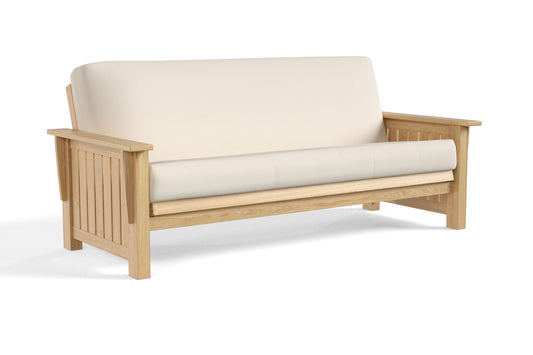
Most Dunlop vs Talalay guidance assumes you're building a thick, layered mattress system where each process handles a specific zone. That's not a futon. A natural futon is typically a thinner, unified build where the materials work together without distinct support and comfort zones. The latex layer, if present, is doing both jobs at once — and it's doing them inside a mattress that may also need to fold on a frame.
This shifts the calculus toward Dunlop for most futon applications:
- Density suits the build. A futon doesn't have a deep upholstery system to buffer the feel of the core materials. Dunlop's denser, steadier character comes through more directly, which typically reads as well-supported rather than stark.
- Recovery under folding. A futon on a convertible frame folds repeatedly. Denser latex holds its shape and recovers more consistently after the compression that comes with folding and unfolding.
- Material alignment. Most natural futon builds are aimed at a cleaner, simpler material story. Dunlop's GOLS certifiability aligns with that approach in a way Talalay currently cannot match.
- Cost efficiency. Futons occupy a value-conscious category even when built with premium natural materials. Dunlop's lower production cost usually translates to better value at equivalent build quality.
Talalay has a legitimate role in a futon when the sleeper specifically wants a softer, more pressure-relieving top feel and is willing to pay for it. It can be used as a comfort layer in a more elaborate futon build, and for side sleepers who need more contouring, it may feel noticeably better. But as a general-purpose latex choice for a futon, Dunlop is the more practical fit.
| Factor | Dunlop | Talalay |
|---|---|---|
| Feel | Denser, firmer, more grounded | Lighter, softer, bouncier |
| Best role in a futon | Support and recovery layer — the full latex job in most builds | Soft comfort layer in more layered builds; side sleeper preference |
| Organic certification | GOLS certification available | 100% natural available; GOLS not currently available |
| Breathability | Breathable, but denser cell structure | More open cell structure, sleeps cooler |
| Durability | Typically 20–25 years for natural Dunlop | Typically 15–20 years for natural Talalay |
| Production cost | Lower — simpler process, less energy | Higher — more steps, more equipment |
-
Natural Cotton and Wool Shiki Futon Mattress
Regular price From $279.99Regular price $419.99 Sale price From $279.99Sale -
Natural All Cotton Shiki Futon Mattress
Regular price From $199.99Regular price $299.99 Sale price From $199.99Sale -
Organic Cotton and Wool Shiki Futon Mattress
Regular price From $429.00Regular price $859.99 Sale price From $429.00Sale -
Organic All Cotton Shiki Futon Mattress
Regular price From $359.00Regular price $719.99 Sale price From $359.00Sale -
Natural Cotton and Wool Japanese-Style Firm Futon Mattress
Regular price From $529.99Regular price $669.99 Sale price From $529.99Sale -
Natural Cotton, Wool and Foam Futon Mattress
Regular price From $469.99Regular price $709.99 Sale price From $469.99Sale -
Natural Cotton, Wool and Latex Shiki Futon Mattress
Regular price From $879.00Regular price $1,759.99 Sale price From $879.00Sale -
Organic Cotton and Wool Japanese-Style Firm Futon Mattress
Regular price From $909.99Regular price $1,139.99 Sale price From $909.99Sale -
Natural Cotton, Wool and Foam Japanese-Style Medium-Firm Futon Mattress
Regular price From $659.99Regular price $829.99 Sale price From $659.99Sale -
Natural All Cotton Japanese-Style Firm Futon Mattress
Regular price From $429.99Regular price $539.99 Sale price From $429.99Sale -
Natural Cotton, Wool and Latex Japanese-Style Medium-Firm Futon Mattress
Regular price From $839.99Regular price $1,049.99 Sale price From $839.99Sale -
Organic Latex and Wool Mattress
Regular price From $1,104.98Regular price $1,699.96 Sale price From $1,104.98Sale