
Bunk Bed Safety: Guardrails, Weight Limits, and What to Check Before You Buy
Most parents shopping for a bunk bed have done some version of the same mental calculation: is this actually safe? The answer is yes for well-built frames, and the specific features that determine the answer are not difficult to evaluate once you know what to look for. The problem is that most product listings don't explain them clearly.
This article covers the safety features that matter — guardrails, weight limits, ladder and staircase standards, and construction quality — so that the decision to buy is made with accurate information rather than general reassurance. Comfort Pure's solid wood bunk beds are designed to meet US safety standards, and understanding what those standards require helps clarify what's actually been built into the frame.

Guardrail Requirements
Guardrails are the most directly safety-critical feature of any top bunk. US federal regulations (ASTM F1427 and 16 CFR Part 1513) require guardrails on both sides of the top bunk — including the side against the wall — with specific gap requirements designed to prevent entrapment.
There are two distinct standards to understand. The entrapment rule requires that gaps within the guardrail structure, and between the bottom of the rail and the bed frame, must be no larger than 3.5 inches — small enough that a child's body cannot slip through and become trapped. The roll-off rule requires that the top edge of the guardrail extends at least 5 inches above the mattress surface, which is why mattress thickness on the top bunk directly affects how much protection the rail actually provides.
A guardrail built 15 inches above the slats with a 10-inch mattress leaves only five inches of effective protection — technically compliant, but with no margin. Staying within the recommended mattress thickness — six inches or under for the top bunk on most Comfort Pure models — keeps the guardrail performing as designed.
Weight Limits: What the Numbers Mean
Every bunk bed lists a weight limit per bunk. These numbers represent the static load the frame is tested to hold — not the dynamic load from a child jumping, rolling, or climbing, which is why responsible manufacturers test to significantly higher loads than the stated limit.
Solid hardwood construction changes this picture meaningfully. A frame built from kiln-dried pine or rubberwood with proper joinery distributes weight across the wood grain and the joint interfaces, not just across the hardware. Screw connections in particleboard or MDF lose purchase over time as the surrounding material compresses under repeated load. Solid wood doesn't degrade this way — which is why the stated weight limits on solid wood frames tend to be more reliable over years of use than equivalent numbers on frames built from engineered materials.
For context: check the weight limit against the actual weight of the intended occupant, with some margin. A frame rated for 200 pounds per bunk used by a 140-pound child has reasonable margin. The same frame used by a 175-pound teenager who has friends over regularly has less margin than it appears.
-
Peppermint Staircase Bunk Bed
Regular price From $1,949.99Regular price Sale price From $1,949.99 -
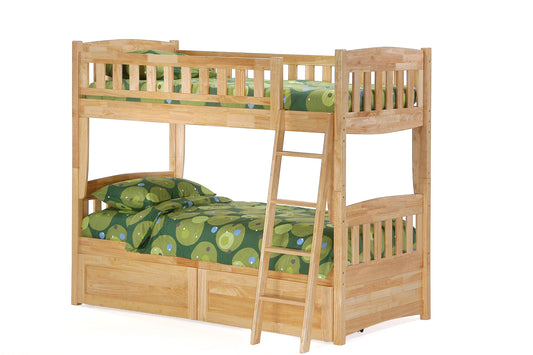
Cinnamon Bunk Bed
Regular price From $1,279.99Regular price Sale price From $1,279.99 -
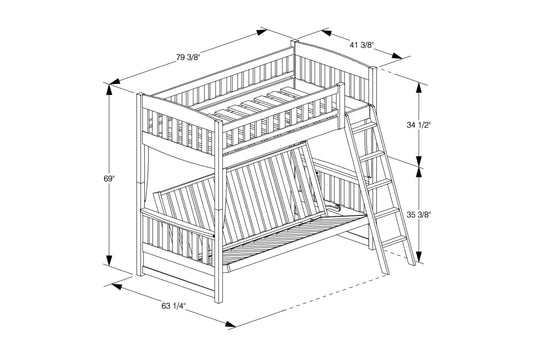
Cinnamon Futon Bunk Bed
Regular price $1,629.00Regular price Sale price $1,629.00 -
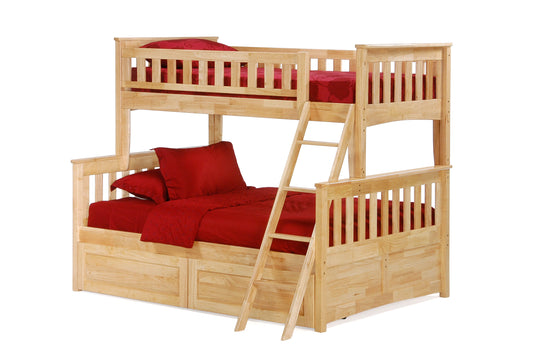
Ginger Bunk Bed
Regular price From $1,689.99Regular price Sale price From $1,689.99 -
Phoenix Bunk Bed
Regular price From $669.99Regular price Sale price From $669.99 -
Sacramento Bunk Bed
Regular price From $819.99Regular price Sale price From $819.99 -
Sacramento Staircase Bunk Bed
Regular price From $1,349.99Regular price Sale price From $1,349.99







Ladder Safety
Ladder safety on a bunk bed is a function of rung width, ladder angle, and mounting security. Rungs that are too narrow — under three inches — are difficult to grip, particularly for younger children. A ladder that angles too steeply — approaching vertical — requires a child to lean back slightly while descending, which is less stable than a moderate angle.
On Comfort Pure's ladder models, the ladder mounts securely to the frame using the same structural hardware as the bed itself. It cannot shift laterally during use, and the mounting points exist on both sides of the frame — so the ladder can be positioned on whichever side suits the room's layout, without compromising the mounting integrity.
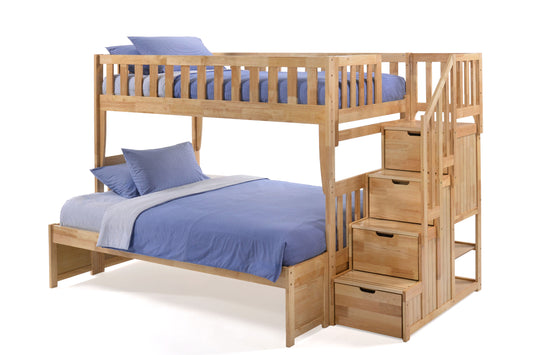
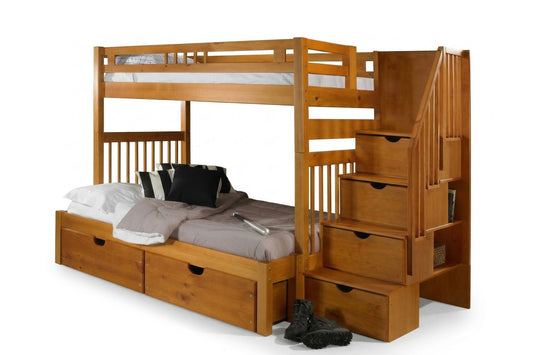
The staircase models — Sacramento Staircase in pine and Peppermint Staircase in rubberwood — replace ladder dynamics entirely with a forward-facing stair descent, which is inherently more stable for children of all ages, particularly younger ones. For a detailed comparison, the stairs vs. ladder guide covers the tradeoffs in full.
Construction Quality as a Safety Factor
Safety standards set a floor. They define minimum guardrail heights, maximum gap dimensions, and minimum weight ratings. What they don't guarantee is that a frame which meets those minimums on the day of assembly will still meet them after three years of use by children.
Joints that rely solely on screws driven into particleboard will loosen over time as the surrounding material compresses. A frame that felt solid at assembly may develop perceptible wobble within two or three years, which is both unpleasant and structurally less safe than a frame that remains tight.
Mortise and Tenon joinery — used in all Comfort Pure bunk bed models — creates a mechanical interlock that holds the joint relationship even as the frame is subjected to lateral forces over time. The joint doesn't rely on screw purchase in soft material; it relies on the geometry of the wood-to-wood connection. This is the construction principle behind furniture that remains solid for decades rather than years.

Assembly and Ongoing Checks
Even a well-built frame benefits from occasional hardware checks. After the first week of use and every six months thereafter, check that the hardware connecting guardrails, ladders, and bed ends to the main frame remains tight. Children's use patterns — particularly climbing and hanging on the rails — put lateral stress on these connections, and catching a loosening bolt early is considerably better than discovering it under load.
This is genuinely easy maintenance on a solid wood frame because the hardware is accessible and the joints it supports are already doing most of the structural work. On frames where the hardware is doing all the structural work, loosening hardware is a more serious concern.
FAQs
What are the guardrail requirements for a bunk bed top bunk?
US standards set two requirements. The entrapment rule requires gaps within the guardrail structure and between the rail bottom and the bed frame to be no larger than 3.5 inches. The roll-off rule requires the top edge of the guardrail to extend at least 5 inches above the mattress surface. Both standards apply, and mattress thickness directly affects compliance with the second.
Does mattress thickness affect guardrail safety?
Yes. The required 5-inch guardrail height is measured from the mattress surface, not from the slats. A thicker mattress reduces the effective rail height above the sleeping child. Keeping top-bunk mattresses at or under six inches maintains the guardrail's intended protective margin.
How often should bunk bed hardware be checked?
After the first week of use and approximately every six months thereafter. Focus on the bolts and connections at guardrails, ladder mounts, and bed end connections, where lateral stress from use concentrates.
What does weight limit actually mean on a bunk bed?
It represents the static load the frame is tested to support per bunk. For solid wood frames with quality joinery, this limit tends to remain reliable over years of use. For frames built from engineered materials, the stated limit may be less meaningful after several years as joints loosen.
Is the ladder or staircase safer for children?
A staircase allows forward-facing descent and provides a full foot landing on each step, which is inherently more stable for younger children. For school-age children with reasonable coordination, a well-mounted ladder is also safe. The choice depends on the child's age, coordination, and how the room's dimensions accommodate each option.
Bunk bed safety is less mysterious than it tends to appear in the purchase process. The standards are specific, the features that matter are identifiable, and the construction quality that sustains safety over years of use — rather than just on the day of delivery — is visible in how the frame is built. A solid wood frame with proper joinery, regulation guardrails, and regular hardware checks is a safe sleeping environment for children over the long term.
For more on the age and developmental factors behind top bunk readiness, the guide on when your child is ready for a bunk bed is worth reading alongside this one.