
Stairs vs. Ladder: Which Is Safer for Kids' Bunk Beds?
Choosing a bunk bed involves more decisions than most parents expect. One that often gets resolved by default — just picking whatever comes standard — is whether to go with a ladder or a staircase. It matters more than it seems, and the right answer depends on who's using the bed and how.
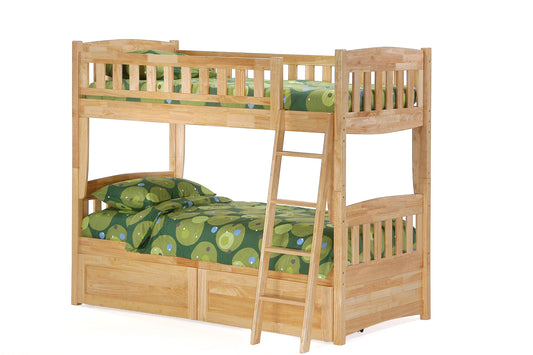
Bunk bed ladders are compact and familiar. They tuck against the frame, take up no extra floor space, and are completely functional for most children over five or six. A well-built ladder on a solid wood bunk bed is a safe way to reach the top bunk — provided the rungs are wide enough to grip comfortably and the ladder is mounted at a reasonable angle rather than nearly vertical.
That said, there are real situations where a staircase is the smarter choice. If you have younger children, kids who get up frequently in the night, or anyone who has ever had the experience of descending a steep ladder half-asleep, the difference is worth thinking through carefully before purchasing. Comfort Pure's solid wood bunk beds are available with both options, and both can be assembled on either side of the frame to suit your room layout.

What the Safety Difference Actually Is
A ladder requires the climber to face the bed, grip the rungs, and step down carefully — a sequence that's straightforward when you're alert but less intuitive when you're tired. For most school-age children this is fine. For kids who are restless sleepers or tend to climb down quickly without thinking, it introduces more risk.
A staircase lets a child descend facing forward, with a full foot landing on each step. There's no gripping required, the body's center of gravity stays low, and the motion is the same as any other stair in the house. That familiarity makes a meaningful difference, particularly for younger children who are just transitioning to the top bunk.
It's worth stating clearly: the CPSC and the American Academy of Pediatrics advise that children under six should not sleep in the top bunk (16 CFR § 1513.6) — regardless of whether the bed has a ladder or a staircase. That guideline stands. If you're confident your child is ready despite being on the younger side of that threshold, a staircase is the more forgiving option: the descent is more intuitive and requires less coordination than a rung-by-rung ladder. But the access method doesn't change the underlying recommendation.
There's also the question of nighttime use for any age. A child who wakes at 2am needing the bathroom will not be at their most coordinated. Parents who choose a staircase often mention this as the deciding factor — not a dramatic safety concern, but a practical one that compounds over years of use.
Footprint and Room Size
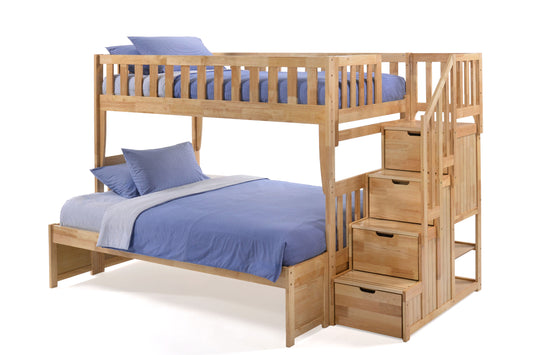
The main tradeoff with stairs is floor space. A staircase bunk bed runs longer than the same model with a ladder, typically adding 18 to 24 inches to the overall footprint depending on the design. This matters in a small bedroom and is worth measuring before you decide.
For example, our Sacramento Staircase Bunk Bed, built from solid kiln-dried pine, measures 104 inches wide when configured with the staircase — compared to 83 inches for the ladder version of the same model. The Peppermint Staircase Bunk Bed, made from eco-rubberwood, has a similar extended footprint. Both staircases can be installed on the left or right side of the frame, so if one wall gives you more room to work with, you can orient accordingly. Whether you're choosing bunk bed stairs or a traditional ladder, the mounting is flexible enough to work around most room configurations.
-
Peppermint Solid Wood Bunk Bed with Storage Stairs
Regular price From $1,949.99Regular price Sale price From $1,949.99 -
Cinnamon Solid Wood Bunk Bed
Regular price From $1,279.99Regular price Sale price From $1,279.99 -
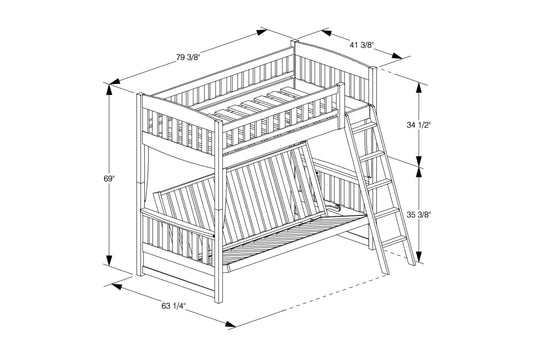
Cinnamon Solid Wood Futon Bunk Bed
Regular price From $1,629.00Regular price Sale price From $1,629.00 -
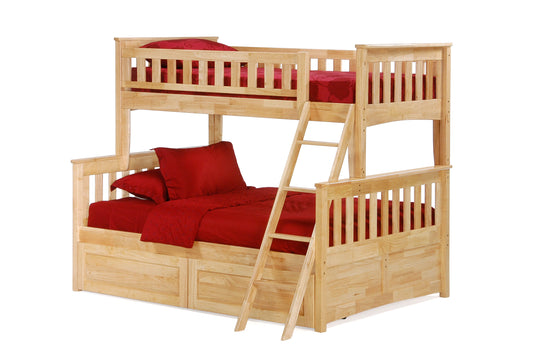
Ginger Solid Wood Bunk Bed
Regular price From $1,689.99Regular price Sale price From $1,689.99 -
Phoenix Solid Pine Bunk Bed
Regular price From $669.99Regular price Sale price From $669.99 -
Sacramento Solid Pine Bunk Bed
Regular price From $819.99Regular price Sale price From $819.99 -
Sacramento Solid Pine Bunk Bed with Storage Stairs
Regular price From $1,349.99Regular price Sale price From $1,349.99







The Storage Advantage
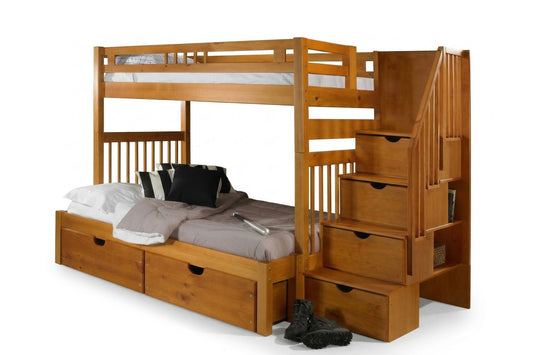
One thing that gets overlooked in the stairs-versus-ladder conversation is that staircase bunk beds aren't just safer for some children — they're also more practical in a shared room. Each step on the Sacramento Staircase and Peppermint Staircase models is a functional storage drawer. In a kids' room that already has two occupants and limited floor space, that built-in storage has real value.
If you're already considering a dresser or additional storage furniture for the room, a staircase bunk bed may reduce or eliminate that need. The drawers hold clothing, books, and smaller items without adding any additional furniture footprint beyond what the staircase already requires.
Stairs vs. Ladder: A Quick Comparison
| Staircase | Ladder | |
|---|---|---|
| Descent style | Forward-facing, full foot on each step | Facing the bed, gripping rungs |
| Best for | Younger children, restless sleepers, nighttime trips | Older children, smaller rooms |
| Floor space | Adds 18–24 inches to bed length | No additional footprint |
| Built-in storage | Yes — each step is a drawer | No |
| Room orientation | Installs on either side | Installs on either side |
Ladder Considerations Worth Knowing
If a ladder is the right choice for your situation, a few details are worth checking regardless of which bed you're looking at. Rung width matters — narrower rungs are harder to grip. The angle of the ladder affects how naturally a child can climb and descend. And the mounting hardware should be fixed and solid, not adjustable in ways that allow movement over time.
On Comfort Pure's ladder models — the Phoenix, Sacramento, Cinnamon, and Ginger — ladders are mounted securely to the frame and don't wobble or shift with use. Both sides of the frame have mounting points, so the ladder goes where it makes most sense for the room. If you're weighing bunk bed stairs versus a traditional rung-style ladder, the key difference is foot placement — steps offer a broader, flatter surface that's easier to use at any hour.

Which One Is Right for Your Family
A useful way to think about it: if your child is younger or a restless sleeper, a staircase is worth the extra footprint if your room allows it. If all your children are school-age and reasonably coordinated, a ladder works well and keeps the bed's overall size more compact.
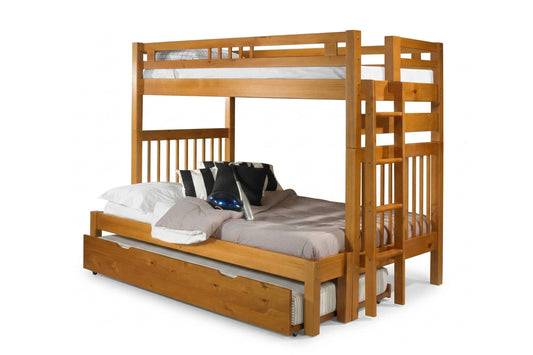
The conversion kit option is also worth noting. All twin/twin models in the Comfort Pure lineup can be converted to twin/full later — so the bed you buy today doesn't have to be the permanent configuration. If you're buying for a younger child now and anticipating a larger lower bunk in a few years, that flexibility matters.
FAQs
Can the staircase be switched from one side to the other after assembly?
Yes. Both the Sacramento Staircase and Peppermint Staircase models allow the staircase to be assembled on either the left or right side of the frame and can be reconfigured if your room layout changes.
What age is appropriate for the top bunk?
The CPSC and American Academy of Pediatrics advise that children under six should not sleep in the top bunk. Beyond age, a child's coordination, sleep habits, and ability to follow instructions consistently are all worth factoring in before making the transition.
Do the staircase drawers lock?
The staircase drawers on both staircase models slide open and closed but do not have locks. They function as standard storage drawers.
How much extra floor space does a staircase add?
Roughly 18 to 24 inches beyond the bed's standard length, depending on configuration. Measure your room carefully before deciding — both staircase models list exact dimensions on their product pages.
Is the staircase as sturdy as the ladder?
Yes. The staircase is integrated into the frame structure, not attached as an accessory. It's built to the same standard as the rest of the bed.
Ultimately, neither option is unsafe when the bed itself is well-made. What changes is how naturally the design fits the child using it and the room it goes into. A staircase makes the climb and descent more intuitive and is the better choice if you have any doubt about nighttime coordination. A ladder keeps the bed compact for tighter spaces and older kids who don't need the extra support. Both are sensible choices — the one that suits your family is the right one.
For more on how Comfort Pure approaches bunk bed construction, the guide on bunk bed safety covers guardrail standards, weight limits, and what to verify before you buy. For parents deciding on the right age for a top bunk, the age and safety guide is a useful next read.