
Natural Bedroom Furniture: How to Verify Real Materials
The popular advice is simple: look for the word natural and choose the piece that looks most like wood. That approach fails. “Natural” can describe a solid-wood frame, but it can also appear on particleboard covered with veneer and polyurethane. The reliable method is to verify the core material, adhesives, finish, emissions documentation, joinery, and repairability.
What Natural Actually Means on a Furniture Label
Natural bedroom furniture isn't a regulated construction category. The FTC's Green Guides don't define “natural,” “organic,” or “sustainable” for furniture, so a manufacturer can use “natural” as marketing language without proving that the piece is solid wood, low-emission, or responsibly sourced. The FTC does warn that broad environmental claims such as “green” or “eco-friendly” need substantiation, but that still leaves “natural” open to interpretation. (FTC Green Guides summary)

That means “natural” might refer only to the visible surface. A dresser can have a thin wood veneer, a composite core, resin-based adhesive, and a conventional lacquer while still being presented as natural. None of those materials automatically makes the furniture unusable, but the label alone tells you very little about what you're bringing into a bedroom.
The same caution applies to “eco-friendly,” “non-toxic,” and “chemical-free.” Chemical-free is not a meaningful furniture specification, and “non-toxic” should prompt a request for the exact standard or test behind the claim. A useful primer on checking broad environmental language is Fillaree's guide to tips for avoiding greenwashing.
Treat the label as a starting point
Ask the retailer for a complete material breakdown, not a style description. You want the wood species, the core material, the back and drawer construction, the finish, and any emissions certification. If a product page says “wood construction” but doesn't distinguish solid wood from veneer-core plywood, MDF, or particleboard, the description is incomplete.
A forestry claim is also separate from a material claim. FSC certification concerns responsible forest management and chain of custody, not whether a product contains formaldehyde-free adhesive or low-emission finish. If responsible sourcing matters to you, look for documentation connected to the specific product or supply chain, such as the information associated with FSC-certified furniture, rather than relying on a leaf icon or the word “natural.”
Practical rule: If the seller can't tell you what the hidden panels and drawer parts are made of, you haven't verified the furniture yet.
Solid Wood Versus Veneer Versus Engineered Panels
The first useful distinction is between what you see and what the piece is built from. Solid wood means the component is made from wood throughout, although it may contain separate boards joined together. Veneer is a real layer of wood applied over another core. Engineered panels, including MDF, particleboard, and plywood, are manufactured sheet materials with different structures and uses.

What product pages should say
A transparent product page uses precise terms:
- Solid wood: Look for wording such as “100% solid oak,” “solid mahogany,” or a named solid species for each relevant component.
- Veneer: Terms such as “oak veneer,” “wood veneer,” or “veneer over plywood” describe the surface, not necessarily the entire panel.
- Plywood: A layered panel made from thin wood sheets. “Veneer-core plywood” identifies a plywood construction with a veneer core, not solid lumber.
- MDF: A dense fiber panel made from refined wood fibers and binders. It has a smooth, uniform edge and is common in painted furniture.
- Particleboard: A panel made from wood particles and resin. It can be functional, but the description should identify it clearly.
A product that says “solid wood frame” may still use MDF drawer bottoms, particleboard backs, or plywood shelves. That wording isn't necessarily deceptive, but you should ask which parts are solid and which are not.
What your eyes and hands can reveal
In person, inspect an unfinished or lightly exposed edge. End grain at the end of a board supports a solid-wood claim. A perfectly uniform, fine-textured edge often indicates MDF, while visible layers suggest plywood. Edge banding can hide a panel edge, so check the underside, drawer opening, rear edge, and hardware cutouts.
Weight helps, but it isn't proof. A dense engineered panel can feel heavier than a hollow or thin solid-wood component. Look at the drawer box, not just the front. A solid-looking drawer face can be attached to a composite box.
Veneer isn't automatically a poor choice. It can provide a stable, attractive surface and use wood efficiently. The trade-off is that a thin surface has less tolerance for aggressive sanding or deep damage. For a more detailed comparison of solid and engineered wood behavior, see this solid hardwood versus engineered wood breakdown.
For buyers prioritizing a solid frame and clear material description, a category such as solid-wood beds gives you a useful reference point, but still read the individual specifications. “Solid” should be confirmed component by component.
Adhesives, Finishes, and Indoor Air Quality
“Natural” does not tell you what a bedroom piece releases into the room. The practical questions concern the resins and finishes. Pressed-wood panels may use formaldehyde-containing adhesives, and coatings can emit VOCs while curing and afterward. Solid wood can reduce the amount of resin-bonded material, yet a supposedly solid-wood piece may still include plywood, MDF, particleboard, adhesive, or a high-emission coating in hidden areas.
The EPA explains that new pressed-wood products can contribute substantially to indoor formaldehyde levels, while solid wood generally produces comparatively low emissions. That distinction matters in a bedroom, where ventilation may be limited during occupied hours. (EPA guidance on formaldehyde and indoor air quality)

Standards that make a claim checkable
TSCA Title VI is the U.S. federal framework for formaldehyde emissions from composite wood products. CARB Phase 2 is California's emissions standard, and finished goods containing composite wood must meet the applicable Phase 2 limits whether they are made domestically or imported. The published limits include 0.05 ppm for hardwood plywood, 0.11 ppm for MDF, 0.13 ppm for thin MDF, and 0.09 ppm for particleboard after the relevant implementation period. (EPA TSCA Title VI information)
These requirements cover specified composite materials, not an entire bedroom set. They do not establish that every component is solid wood, and they say nothing about durability, forestry, or every finish ingredient. Ask for documentation identifying the panels used in the actual product and confirming their compliance.
GREENGUARD evaluates emissions from the finished product. GREENGUARD Gold applies tighter requirements for sensitive environments, including children's rooms, and screens for more than 15,000 VOCs. (GREENGUARD furniture guidance)
Finish choice affects use as well as smell
- Oil finishes soak into the surface and are usually easy to refresh. They can show marks readily and generally need periodic care.
- Wax leaves a soft, tactile surface but offers less resistance to water and abrasion than a harder film finish.
- Water-based finishes use water as a major carrier and may produce fewer solvent odors during application. The full formulation still determines emissions and performance.
- Conventional lacquer forms a hard, consistent film, but it may release solvent odors while curing and can be difficult to repair invisibly.
“Low VOC” describes emissions from a formulation. It does not mean the finish contains no chemicals. Request the finish name, technical data sheet, curing instructions, and any finished-product certification. A category such as non-toxic furniture can help narrow a search, but its label still needs to be checked against product documentation.
A finish claim is credible only when the maker can identify the product or provide test results. For a home where source control has already been addressed, this guide to the best air purifier for VOCs offers practical background on reducing airborne exposure.
| Claim | Backed By | How to Verify |
|---|---|---|
| Solid wood | A component-level material specification | Ask whether the frame, panels, drawers, backs, and slats are all solid wood |
| Low formaldehyde composite wood | TSCA Title VI or CARB Phase 2 documentation | Request the applicable compliance statement and panel details |
| Low emissions from the finished product | GREENGUARD or GREENGUARD Gold certification | Search the certification listing or request the certificate for the exact product |
| Responsible forestry | FSC certification and chain-of-custody documentation | Check the product claim and certificate details at FSC |
| Low-VOC finish | Finish technical data or a finished-product emissions test | Ask for the finish's technical data sheet, formulation category, and test documentation |
| “Natural” | Usually a self-declared marketing description | Ask what the word refers to, then verify each material, adhesive, and finish separately |
Wood Species, Joinery, and Long-Term Durability
A natural material is only sustainable in practice if the furniture survives daily use. The USDA Forest Products Laboratory's wood database is a useful source for comparing species by Janka hardness, a measure of resistance to indentation. Hardness matters for dents and wear, but it isn't the whole durability story. Grain, movement, stability, board quality, joinery, and finish all affect how a bed or dresser ages. (USDA Forest Products Laboratory wood database)

Species selection is about the job
Oak has prominent grain and good resistance to everyday knocks, making it a practical choice for bed frames, dressers, and frequently used storage. Cherry is smoother and tends to develop a deeper, richer appearance with age. Mahogany is valued for its workable grain and warm appearance, while beech has a fine, even texture and is often chosen where a clean surface matters.
Bamboo is a grass, not a botanical hardwood, although laminated bamboo furniture can be hard and stable. Its performance depends heavily on how the strips are processed and bonded, so “bamboo” doesn't tell you whether the piece is solid, laminated, or composite.
| Wood Species | Hardness | Best Bedroom Use |
|---|---|---|
| Oak | Relatively hard, with strong visible grain | Bed frames, dressers, and high-contact storage |
| Cherry | Medium hardness with smooth grain | Dressers, nightstands, and refined case goods |
| Mahogany | Durable hardwood with workable grain | Bed frames and substantial bedroom furniture |
| Beech | Hard, fine-grained, and even-textured | Drawers, bed components, and clean-lined furniture |
| Bamboo | Hardness varies by laminated construction | Shelves, nightstands, and lightweight storage |
Joinery tells you how the piece can age
Dovetail joints in drawer boxes resist the pull created by repeated opening. Mortise-and-tenon joints, where one part fits into a shaped pocket in another, provide a strong traditional connection for frames. Dowel joints can be durable when accurately machined and properly glued. Cam-lock fittings support efficient assembly and flat packing, but they're more dependent on hardware quality and the surrounding panel material.
Look for replaceable runners, accessible fasteners, and parts that can be tightened or repaired. Construction quality is a sustainability argument in itself. A repairable dresser that remains useful is a better long-term purchase than a fashionable piece that must be discarded after one failed joint.
Solid wood is hygroscopic. It shrinks in dry air and swells in humid air as it moves toward equilibrium moisture content. Care guidance commonly targets about 50% relative humidity, with attention recommended below roughly 45% RH, because winter interiors can fall to 20% RH or lower and accelerate gaps, shrinkage, and joint stress. (Solid-wood furniture care guidance)
Wood-care rule: Keep solid furniture away from radiators and HVAC vents, and choose joinery that allows boards to move rather than trapping them rigidly.
Category Checklist and Questions to Ask Before Buying
Different bedroom categories fail in different places. A bed needs reliable load paths and quiet connections. A dresser needs drawer boxes, runners, and anti-tip hardware that can handle repeated use. A nightstand needs stable joints and a finish that tolerates cups, lamps, and cleaning. Storage pieces need shelves, backs, doors, and hardware that match the intended load.
Check the category, not just the photograph
Beds: Confirm whether rails, legs, slats, center supports, and headboards are solid wood or mixed construction. Ask how the joints tighten, whether the slats are replaceable, and whether the design accommodates seasonal movement.
Dressers and chests: Open every drawer. Look for dovetail or well-made dowel construction, solid or clearly specified drawer bottoms, smooth runners, and a back panel that isn't left undescribed. Confirm that anti-tip hardware is included or specified.
Nightstands: Inspect the underside, rear panel, and drawer box. Small pieces often reveal construction shortcuts because buyers focus on the visible top and front.
Storage: Check shelf thickness, support spacing, door alignment, hardware, and wall-anchoring provisions. A tall cabinet should have a clear stability plan, especially in a family bedroom.
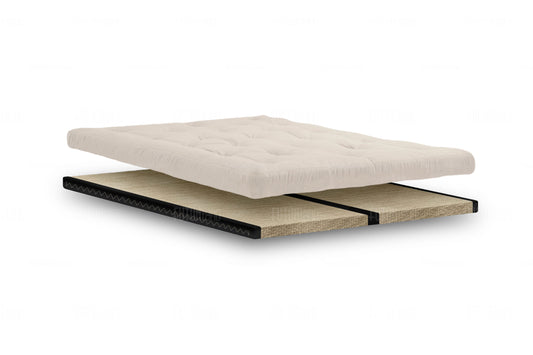
The Japanese Tatami Platform Bed with Slatted Headboard is described as 100% solid Indonesian mahogany hardwood with wooden slats, a center rail, and interlocking joinery that assembles without screws or brackets. Its glossy finish and floor clearance are also specified, while the product notes that a Tatami mat, or plywood over the slats, pairs with the frame for added support.
Questions worth asking before payment
- What is the exact material for every major component, including backs, drawer boxes, shelves, and slats?
- Is the visible wood solid lumber, veneer, or a printed finish?
- Which adhesives or resin binders are used in composite panels?
- Does the product meet TSCA Title VI or CARB Phase 2 requirements?
- Is the finished piece GREENGUARD or GREENGUARD Gold certified?
- What finish is applied, and what are the curing and care instructions?
- Is the timber FSC certified, and does the certification apply to this specific product?
- Which joints are used, and can runners, slats, or hardware be replaced?
- What does the warranty cover, and what parts remain available for repair?
A transparent retailer should answer these without sending you back to vague lifestyle language. Comfort Pure's materials reference pages, case goods collection, and dresser collection can serve as useful examples of the level of product detail buyers should seek, including the separate wood references for oak furniture, cherry furniture, mahogany furniture, beech furniture, and bamboo furniture.
Textiles deserve the same scrutiny. Upholstered headboards, benches, and storage ottomans may include textile covers, foam, batting, latex, or adhesives. GOTS applies to qualifying textile fibers and processing, while GOLS applies to certified organic latex components. Neither certification proves that the frame is solid wood or that every adhesive and finish in the piece has low emissions. For a broader look at certification boundaries, use the eco-certifications article once it has been updated as a dedicated certifications resource.
For compact rooms, a flat-pack solid-wood piece can make delivery and assembly easier, but verify whether flat-pack construction uses solid boards, plywood, MDF, or particleboard in each component. Easy assembly isn't the same as long-term repairability.
The Final Verdict and Common Questions
The right natural bedroom furniture isn't the piece with the most convincing label. It's the one whose materials, hidden components, finish, emissions documentation, joinery, and sourcing claims can be checked. Solid wood can reduce dependence on pressed panels, but it still needs appropriate humidity, careful placement, and a durable construction plan.
A certification should answer a specific question. FSC addresses forestry and chain of custody. GREENGUARD Gold addresses indoor-air emissions from the finished product. GOTS and GOLS apply to qualifying textile and latex components. None of them replaces a complete spec sheet.
Common questions
Is solid wood always better than engineered wood?
No. Solid wood offers repairability and can avoid extensive resin-bonded panels, but it moves with humidity and can develop gaps or joint stress if poorly designed or badly maintained. Engineered panels can be stable and useful when their emissions compliance, edge treatment, and construction quality are clearly documented.
Does natural mean non-toxic?
No. “Natural” has no built-in federal definition for furniture. Ask what the term refers to, then check composite-panel standards, finish information, ventilation guidance, and any independent finished-product certification.
Is bamboo a hardwood?
No. Bamboo is a grass. Furniture made from laminated bamboo strips can be hard and durable, but the product description should explain how it's constructed and what binders or finishes it uses.
What finish is safest?
There isn't one universal answer. Choose a finish with clear product information and suitable emissions documentation. Oils and waxes can be easier to refresh, while water-based finishes and conventional lacquers differ by formulation, curing behavior, film strength, and repair method.
How do you know if a piece is real solid wood?
Read the component-level specifications and inspect hidden edges. Look for end grain, consistent board construction, and explicit statements covering the frame, panels, drawers, backs, and slats. A veneer over MDF can look like solid wood from across a showroom.
Should bedroom furniture be GREENGUARD Gold certified?
It's a meaningful option for buyers who want independent emissions screening. GREENGUARD Gold evaluates the finished product against tighter requirements than the standard certification, but it doesn't prove solid-wood construction, FSC sourcing, or long-term durability.
Is veneer always a bad choice?
No. Quality veneer can be attractive and stable. The important questions are what lies beneath it, which resin binders were used, how thick and repairable the surface is, and whether the manufacturer describes the core accurately.
Why does joinery matter to sustainability?
Strong, serviceable joints keep furniture in use longer. Dovetails, mortise and tenon, and accurately made dowels can support repairable construction, while cam-lock systems require closer inspection of hardware and panel quality.
Choose your next piece by requesting the full specification sheet before you buy. Compare the core, finish, emissions documentation, certification scope, and joinery, then browse the non-toxic furniture collection with those questions in hand.
[shop_natural_furniture]