
Organic Down Comforter: What the Label Really Means and How to Choose the Right Fill
If you're shopping for a healthier comforter, the first question isn't whether you want down or wool. It's what the label means.
That matters because "organic down comforter" is a phrase that sounds clearer than it is. Sometimes it refers to the outer fabric. Sometimes it refers to the whole product. Sometimes it's being used loosely, with no explanation of what is certified and what isn't. A good natural comforter should be simple to understand: shell, fill, sourcing, and construction — with certifications that tell you which part of that story has actually been verified.

What "Organic Down Comforter" Actually Means
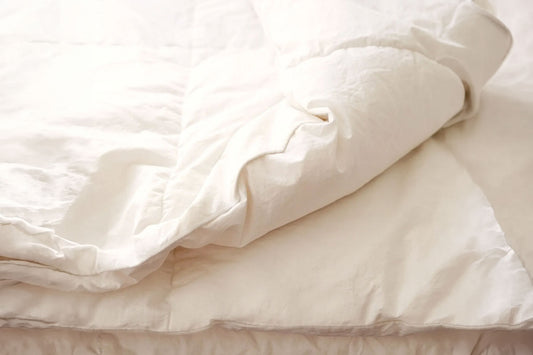
A down comforter has two distinct material parts. The shell is the outer fabric. The fill is the down inside it. When a brand uses the word organic, it most commonly applies to the shell — typically the cotton fabric — not to the down itself.
That's not a technicality to dismiss. It's the most important thing to understand when comparing products in this category.
Organic cotton shells are typically certified under GOTS (Global Organic Textile Standard), which covers fiber origin, processing, and manufacturing standards. A GOTS-certified cotton shell is a meaningful claim — it tells you the fabric was made from organically grown cotton using restricted chemical processing.
Down, however, doesn't have an organic certification equivalent to GOTS or GOLS. There is no "certified organic down" standard that works the way organic textile certification does. So when a product is labeled "organic down comforter," the honest question to ask is: which part is certified, and by whom?
A transparent answer from a credible brand usually looks like this: an organic cotton shell certified under GOTS, RDS-certified down fill, and OEKO-TEX Standard 100 on the finished product. Those three together cover the textile, the sourcing ethics of the fill, and the finished product's safety profile. Any listing that uses "organic down" without explaining those distinctions is borrowing the credibility of the cotton certification and extending it to the fill.
Understanding the Certifications
GOTS (Global Organic Textile Standard) is the standard to look for on the shell fabric and any textile components. It covers cotton, wool, and other natural fiber textiles from farm to finished fabric — including restrictions on dyes, chemical treatments, and processing agents. GOTS certification on a comforter shell is a meaningful, checkable claim. It does not cover the down fill.
RDS (Responsible Down Standard) addresses the down directly. It verifies that the down has been traced through the supply chain and that practices like live-plucking and force-feeding are prohibited. RDS doesn't make down organic in the agricultural sense, but it provides the closest verifiable standard available for down sourcing ethics. For buyers who want to use down and care about animal welfare, RDS is the benchmark to look for — and its absence from a product description is a reason to ask questions.
OEKO-TEX Standard 100 tests finished materials for over a thousand harmful substances — residual chemicals, heavy metals, dyes, and other inputs that may remain in the product after manufacturing. It doesn't verify organic sourcing, but it confirms the finished product won't expose you to identified harmful substances. For a category where chemical processing of cotton shells is common, OEKO-TEX is a practical check on the complete product rather than just on the raw materials.
The clearest frame for reading these labels: "organic" usually belongs to the cotton shell. "Ethically sourced" belongs to the down. OEKO-TEX belongs to the finished product. A comforter that does all three has covered most of what matters for a cleaner, more traceable product.
Down vs Wool: A Practical Comparison for Sleepers
Down and wool are often discussed as if one is premium and the other is a fallback. They're not — they solve different sleep problems.
What down does better. Down is an efficient insulator. It traps air well, lofts high, and provides warmth without a heavy, dense feel. That combination makes it the natural choice for cold sleepers who want maximum warmth without the weight. A cotton shell allows down to breathe and loft properly, which is why shell material matters as much as fill quality.
What wool does better. Wool is less about insulation and more about temperature regulation. Rather than trapping warmth passively, wool fibers absorb and release moisture as body temperature changes — which is why many sleepers who go from cool to warm during the night find wool more comfortable than down. It doesn't have the same puffy, cloudlike look as a high-fill-power down comforter, but it often performs better for variable sleepers, couples with different temperature preferences, and anyone who finds down too warm after the first few hours of sleep.
| Feature | Down | Wool |
|---|---|---|
| Warmth feel | Lofty, insulating, light for the warmth level | Steady, buffered warmth with less loft |
| Weight | Lighter at the same warmth level | Slightly denser and more grounded |
| Breathability | Very breathable when paired with cotton shell | Breathable, with active moisture management |
| Temperature pattern | Best for sleepers who stay consistently cool | Best for hot-cold swings and variable sleep temperature |
| Appearance on the bed | Puffy and cloudlike | Flatter and more tailored |
| Values question | Best when RDS-certified sourcing is important to you | Good fit for buyers who prefer wool's sourcing profile |
| Allergy sensitivity | Many sensitive sleepers do fine with well-cleaned down | Often preferred for its natural dust mite resistance |
A simple framework helps most buyers land on the right choice:
- You run cold most nights → down usually makes more sense
- Your temperature swings from cool to warm, or you wake up overheated → wool is often the better call
- You want the lightest feel possible → down has the edge
- You want one comforter that handles a wide range of seasonal conditions → wool is hard to beat
- Animal welfare around down sourcing is a concern → wool may feel more aligned, depending on the husbandry standards behind it
If you want to avoid animal products entirely, both down and wool are animal-derived fills. In that case, the right path is a plant-based or cotton fill — and that's a clear decision, not a compromise.
For merino wool specifically, the myMerino collection shows the kind of wool construction that temperature-variable sleepers tend to look for — finer fiber, softer hand, and consistent year-round use.

Understanding Fill Power and Construction
For down specifically, two technical details decide most of the real-world performance difference between products.
Fill power measures how much space one ounce of down occupies — essentially, how efficiently the down insulates relative to its weight. Higher fill power means larger, more mature clusters that loft better and provide more warmth per ounce.
- Below 500 fill power is generally considered low quality for bedding purposes — heavier relative to its warmth
- 600 to 700 fill power is a solid range for all-season comforters — good warmth-to-weight ratio, practical for most bedrooms
- 700+ fill power is considered excellent — you get meaningful warmth with less actual down, making the comforter lighter
- 850+ fill power is top-end — maximum loft and warmth retention at minimal weight
Higher fill power isn't automatically better for every sleeper. A hot sleeper can still choose the wrong comforter if the total warmth level is too high for their room. Fill power describes insulation efficiency; warmth level depends on how much fill is actually used.
Baffle-box construction uses internal fabric walls sewn between the top and bottom layers of the comforter to create three-dimensional boxes. This keeps the down distributed evenly rather than migrating to the edges or corners, prevents cold spots from forming at the stitching lines, and supports longer product life. It's more complex to manufacture than sewn-through construction, which is why it typically appears in better-made products.
Sewn-through construction stitches the top and bottom layers directly together. It's lighter and simpler, but the flat seam lines create areas where down can't reach full loft, which means slightly uneven warmth distribution. In practice, this matters more when the comforter is used without a duvet cover; the cover moderates the difference.
The shell material matters too. A breathable cotton shell allows down to loft and release moisture properly. A tight weave is needed to prevent down from migrating through the fabric; a high-quality cotton shell achieves this without sacrificing breathability. Synthetic shells work against the down's performance by trapping moisture rather than releasing it.
-
Alpaca Wool Comforter (Duvet Insert)
Regular price From $319.00Regular price Sale price From $319.00 -
Down Comforter (Duvet Insert)
Regular price From $339.00Regular price Sale price From $339.00 -
myComforter®
Regular price From $149.00Regular price Sale price From $149.00 -
myComforter® Light
Regular price From $139.00Regular price Sale price From $139.00 -
myMerino® Comforter
Regular price From $179.00Regular price Sale price From $179.00 -
myMerino® Comforter Light
Regular price From $159.00Regular price Sale price From $159.00 -
Wool Comforter (Duvet Insert)
Regular price From $549.00Regular price Sale price From $549.00