
Buckwheat Pillow vs Latex vs Memory Foam: Which Support Logic Fits You?
Most pillow frustration follows the same pattern. The pillow feels acceptable the first night. Then it goes flat, bunches under the neck, or traps warmth against the face. By morning the head never found a stable place to rest. That's when people start comparing natural pillow options — and usually land on the organic latex vs memory foam question.
Both can be real improvements over fiberfill. But neither is the only option worth understanding. Buckwheat takes a materially different approach to support: instead of a foam that compresses or rebounds, buckwheat hulls shift, settle, and hold shape. The result is a pillow that works through mechanical structure rather than cushioning. That difference is practical, not just philosophical — and it changes who the pillow suits and who it doesn't.

Why the Usual Foam Comparison Only Gets You So Far
Memory foam and organic latex both solve pillow problems, but they solve different ones.
Memory foam contours closely to the head and neck through heat and pressure. It absorbs movement well and creates a cradled feel many sleepers like. The trade-offs are mechanical: the material recovers slowly after you move, which can make repositioning feel effortful, and dense foam retains heat near the face. A 2022 study published in Chemosphere that measured VOC emissions from memory foam over 31 days also found that emissions of compounds including acetone, toluene, and chloromethane peaked on day one and continued at lower levels for weeks — a relevant consideration for anyone choosing a pillow for a primary sleep environment.
Organic latex responds differently. Its open-cell structure means it bounces back immediately when you shift positions, without the slow-sink recovery of memory foam. It tends to sleep cooler. It's a natural material with no synthetic VOC emissions. For sleepers who found memory foam warm or sluggish, latex often feels like the obvious upgrade.
But both materials share a structural characteristic: they behave as a single piece. You compress them, and the whole body deforms and returns. That works well for many people. For sleepers who need more precise, adjustable neck support — particularly those who've been folding, doubling, or rebuilding their pillow through the night — a single-piece foam structure may still not be the right answer.
What Buckwheat Actually Does
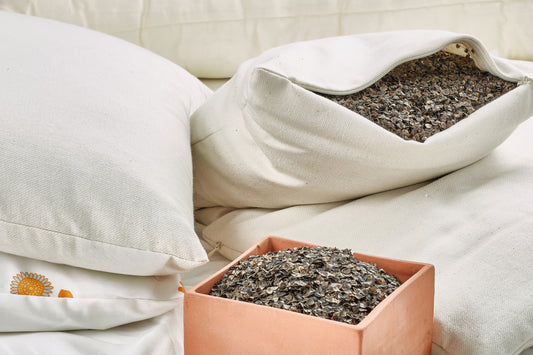
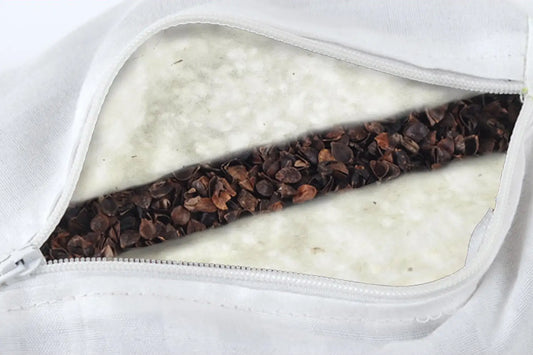
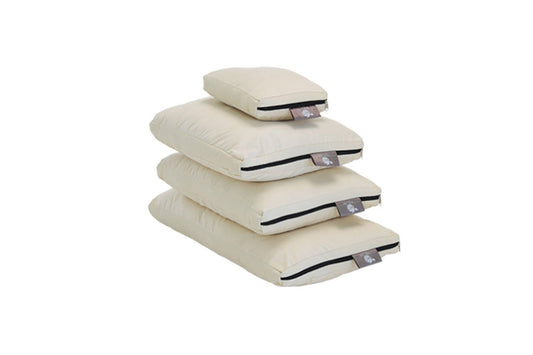
A buckwheat pillow is a fabric shell filled with buckwheat hulls: the hard angular outer casings of buckwheat seeds. Each hull is small, firm, and faceted. When thousands of them fill a pillow, they interlock loosely. When you lie down, they shift under the weight of your head, arranging themselves into the contour your position creates — then they stop moving and hold that shape until you move again.
That's a different mechanism than foam. Foam deforms as one body. Buckwheat redistributes itself into a custom contour and stays there.
The practical results:
- The pillow fills the hollow under the neck and holds that fill after your head settles, rather than gradually compressing flat
- Air circulates between hulls, so the pillow doesn't build up heat against the face the way a continuous foam mass can
- Fill level is adjustable — you can add or remove hulls to change loft, which means the pillow can be tuned to your shoulder width, sleep position, and preference rather than accepting a fixed profile
This is why buckwheat has a different feel from either foam option. It doesn't try to cushion through compression. It supports through structure.
A Comparison Across the Three Materials
| Attribute | Buckwheat hulls | Organic latex | Memory foam |
|---|---|---|---|
| Support mechanism | Hulls shift into shape then interlock and hold | Elastic foam rebounds immediately after compression | Viscoelastic foam softens with heat and pressure, slow recovery |
| Feel | Firm, moldable, precise under neck | Springy, buoyant, responsive | Contouring, slow, cradled |
| Breathability | High — air moves freely between hulls | Good — open-cell structure | Lower — dense foam retains heat near face |
| Loft adjustability | Full — add or remove hulls freely | Limited unless shredded latex; fixed in solid form | Fixed in most forms; limited in shredded versions |
| Repositioning | Reshapes when hulls shift | Springs back immediately | Slow to recover — can feel "stuck" when changing position |
| VOC emissions | None — raw natural fill | None from natural latex | Measurable VOC emissions especially when new |
| Sound | Audible rustle when hulls shift | Silent | Silent |
| Weight | Heavy — 5 to 8 lbs typical | Moderate to heavy | Moderate |
| Lifespan | 10+ years; hulls can be replaced | 5 to 7+ years | 2 to 3 years typical before compression loss |

Where Each Material Fits
Choose buckwheat when your priority is stable neck support that holds its shape through the night, adjustable loft you can tune to your actual position, and airflow that prevents heat from building up near the face. It suits back and side sleepers who have been dealing with flat pillows or who fold and reposition their pillow repeatedly through the night. The firm, structural feel is the point — it doesn't soften like foam, and for sleepers who find foam too warm or too slow, that's an advantage rather than a limitation.
Choose organic latex when you want a natural material with no synthetic emissions, a responsive feel that springs back immediately when you move, and more surface softness than buckwheat provides. Latex suits combination sleepers well because the pillow resets on its own without manual repositioning. It also tends to feel more familiar to people coming from conventional foam — same general concept, cleaner materials, better durability.
Choose memory foam when deep contouring and pressure relief are the priority and the slow, dense feel doesn't bother you. Memory foam works well for sleepers who like a cradled sensation and don't move much through the night. The main practical trade-offs — warmth, VOC emissions at first, and a shorter useful lifespan than natural alternatives — are worth accounting for in the decision.
The Clinical Evidence Worth Knowing
A crossover study published in the Korean Journal of Health Promotion (Lee and Lee, 2019) had 30 participants use buckwheat and latex pillows for two weeks each, measuring neck pain, shoulder pain, and neck disability index scores before and after. Both materials reduced neck pain scores. Buckwheat also produced a statistically significant reduction in shoulder pain scores; latex did not. The researchers noted that buckwheat's moldable contouring and loft-adjustability likely contributed to the broader pain outcomes.
The sample was small and specific to elderly participants, so the results shouldn't be overgeneralized. But it's a useful data point: both materials can support neck alignment meaningfully better than collapsing fiberfill, and buckwheat's structural adjustability may give it an edge for shoulder-pain relief specifically.
The Trade-offs Buckwheat Asks You to Accept
Buckwheat has real advantages, but three trade-offs matter and are worth stating plainly:
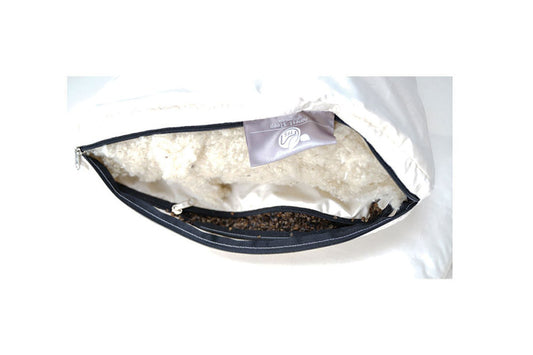
Firmness. A buckwheat pillow is substantially firmer than most fiberfill and typically firmer in feel than latex or memory foam. The hulls resist compression. If you want a soft, plush pillow that disappears under your head, buckwheat won't be it — not even with fill adjustments. Some people soften the contact layer by choosing a wool-and-buckwheat version where a wool surface sits above the hull chamber, but the underlying support character stays firm.
Sound. Shifting hulls make a dry rustling noise. Many people stop noticing it within a few nights. Very light sleepers who are sensitive to sound during sleep onset may not adapt, and that's a legitimate reason to choose a different fill.
Weight. A buckwheat pillow is heavy — typically 5 to 8 pounds depending on fill level. It doesn't toss or bunch easily. For sleepers who like to constantly reposition a light pillow, that groundedness can feel restrictive rather than stable.
None of these are flaws in the design. They're properties of the material. Knowing them in advance means you're choosing buckwheat for the right reasons rather than being surprised by the adjustment.
Adjusting Loft: The Practical Step Most People Skip
The most common reason buckwheat pillows don't work for a new user isn't the material — it's the fill level. Most buckwheat pillows ship overfilled to give people room to adjust downward. An overfilled buckwheat pillow pushes the head too far forward, creates neck strain, and feels like a block rather than a support surface.
The right approach:
- Start with the pillow as it arrives and lie in your actual sleep position
- Note whether the head is tipping back (too low) or chin pressing toward chest (too high)
- Remove small amounts of hull fill until the head and neck feel level and the neck feels supported without being pushed
- Store the extra hulls in a clean, dry container — you may want to add some back as you adjust to the feel
The correct fill level for side sleepers is typically higher than for back sleepers — enough fill to span the distance between the mattress and the side of the head without the head dropping. Back sleepers need a lower, more moderate fill that supports the neck curve without pushing the chin forward. Stomach sleepers generally need very little fill, and many will be more comfortable with a different pillow type entirely.
Wool as a Fourth Option and Bridge Material
Wool doesn't get discussed in the usual latex vs memory foam framing, but it belongs in any honest pillow material comparison. Wool compresses as a fiber mass, manages moisture exceptionally well, and provides a softer contact surface than either buckwheat or latex. It doesn't create the defined neck contour that firm fills provide, and it tends to compress more over time than latex or buckwheat — but for sleepers who want a softer, more natural sleep surface without the structure of hulls or the spring of foam, wool fills a real gap.
Wool is also the most useful bridge between buckwheat and softer options. A pillow that combines a buckwheat hull core with a wool outer layer softens the immediate contact feel while preserving the structural support from the hulls underneath. For someone coming off years of soft synthetic pillows, that combination can make the adjustment to structured support easier than going straight to pure buckwheat.
For more on how wool behaves in bedding and how it compares to synthetic fills across different sleep conditions, this guide to buckwheat vs latex pillows covers the comparison in practical terms.
-
Buckwheat Pillow
Regular price From $33.00Regular price Sale price From $33.00 -
Organic Wool and Buckwheat Pillow
Regular price From $98.98Regular price $197.96 Sale price From $98.98Sale -
Organic Cotton and Buckwheat Pillow
Regular price From $93.98Regular price $187.96 Sale price From $93.98Sale -
Organic Cotton Pillow
Regular price From $93.98Regular price $187.96 Sale price From $93.98Sale -

 Sale
SaleOrganic Wool Pillow
Regular price From $118.98Regular price $237.96 Sale price From $118.98Sale -
 Sale
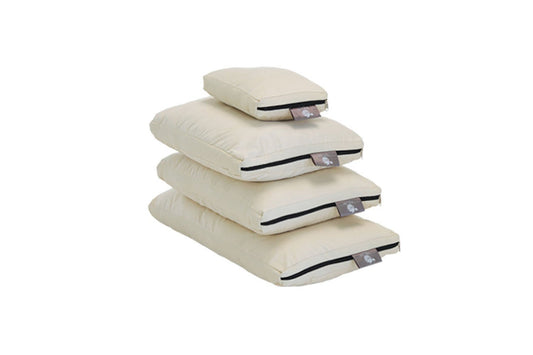
SaleNatural Wool Pillow
Regular price From $103.98Regular price $207.96 Sale price From $103.98Sale -
 Sale
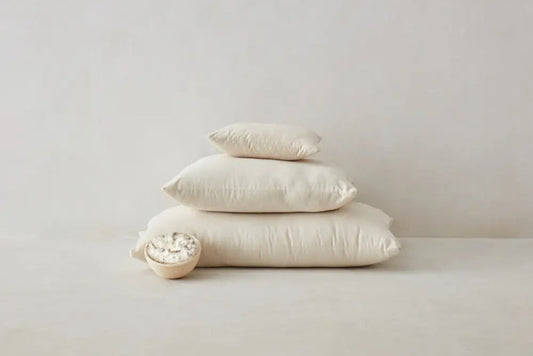
SaleNatural Kapok Pillow
Regular price From $103.98Regular price $207.96 Sale price From $103.98Sale -
Natural Shredded Latex Pillow
Regular price From $103.98Regular price $207.96 Sale price From $103.98Sale -
myMerino® Pillow
Regular price From $159.00Regular price Sale price From $159.00 -
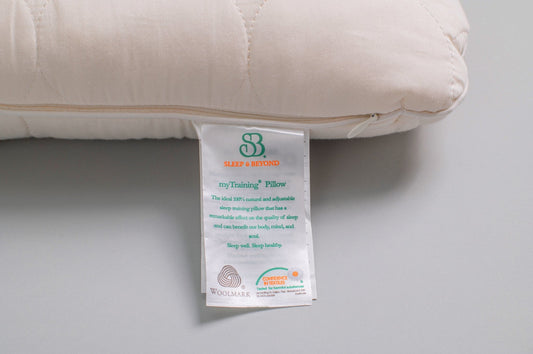
myTraining™ Pillow
Regular price $159.00Regular price Sale price $159.00 -
Organic Kapok Pillow
Regular price From $145.00Regular price Sale price From $145.00 -
Natural Wool and Latex Pillow
Regular price From $175.00Regular price Sale price From $175.00