
Weight Limits on Futon Frames: Why Heavy Adults and Couples Need Solid Hardwood
You've probably seen the listing: a futon with a "400 lb weight capacity," priced at $280, shipping in a flat box. It looks fine in photos. Then two adults sit down at the same time, and something gives. Maybe a creak, maybe a crack. Either way, you already know the frame won't make it to next year.
This isn't bad luck. It's the predictable result of how cheap furniture is built—and how weight limits are calculated and advertised, two things the industry has quietly kept vague for decades.
If you're a heavier adult, part of a couple using a futon as a primary bed, or furnishing a rental where guests are harder on furniture than owners are, the standard market options will let you down. Here's what's actually going on with futon weight limits, and what a frame has to be made of to hold up long-term.
The Fast Furniture Trap: Pine, MDF, and Weak Metal
To keep shipping weights light and prices low, most mass-market futon frames are built from one of three materials—and each has a specific, predictable failure mode:
MDF and particleboard are compressed wood fiber and sawdust held together with synthetic resin. A screw driven into MDF holds reasonably well at first. But every time someone sits down, the joint moves slightly. The screw works against the surrounding material, the sawdust compresses, the hole widens, and eventually the joint just pulls apart. There's no repairing it—once the MDF around a screw hole fails, that joint is gone.
Pine and other softwoods are often sold as "solid wood," which is technically accurate but misses the point. Pine is a fast-growing softwood with low density. It dents under concentrated pressure, bends under sustained load, and doesn't hold hardware as securely as a hardwood does. Used occasionally in a guest room, a pine frame might last a few years. Used nightly by two adults, it shows structural problems within months.
Hollow metal tubing looks sturdy and photographs well, but the failure mode is different from wood. Instead of screws stripping, the tubing buckles or the weld points crack under repeated heavy loads. Once a hollow tube bends at a stress point, the folding mechanism never works correctly again.
The result is a staggering volume of discarded furniture. According to the Environmental Protection Agency, Americans discard over 12 million tons of furniture and furnishings each year—a significant portion of it fast furniture that simply couldn't withstand everyday use.

Static Weight vs. Dynamic Weight: The 400-Pound Myth
When a manufacturer lists a "400 lb weight capacity," they're almost always referring to static load—the weight of an object placed gently and evenly across the full mattress surface. Think sandbags, not people.
People generate dynamic load. When a 200-pound adult drops onto a futon after a long day, gravity multiplies the impact. At the moment of contact, the force is significantly higher than 200 pounds—concentrated on a small area of the slats and hinge, not distributed evenly across the whole surface. Two people sitting down simultaneously can spike past 500 pounds of dynamic force in a fraction of a second.
A frame built from MDF or thin pine can pass a 400-pound static load test. It cannot absorb that same weight as a dynamic impact without something giving—a screw stripping, a slat cracking, a hinge bending. The frame didn't fail to perform; it was never designed for this use case.
Why Hardwood Behaves Differently
Oak, cherry, and maple take 50 to 100 years to reach harvesting maturity. That growth period produces tightly packed wood fibers that resist compression and bending under load—not just because of material strength, but because of how a well-built hardwood frame distributes force.
The joinery method matters as much as the species. The best hardwood futon frames use traditional mortise-and-tenon construction: a precisely cut tenon (a protruding tongue of wood) fits into a corresponding mortise (a cavity in the receiving piece). The joint is mechanical—the two pieces interlock. Glue and hardware reinforce an already stable connection rather than being the only thing holding it. Contrast that with the typical flat-pack approach: two pieces of MDF held by a single bolt through a pre-drilled hole, where the bolt and the surrounding sawdust carry the entire load.
When someone drops onto a hardwood futon built this way, the dynamic force travels through the joints and disperses into the frame as a whole. There's no single weak point absorbing all of it. A solid hardwood futon frame constructed with traditional joinery can handle 500 to 600 pounds of dynamic load and remain structurally sound years later—because the load distribution is architectural, not just a matter of material strength.
| Frame material | Dynamic load handling | Typical lifespan | Common failure mode |
|---|---|---|---|
| Solid hardwood (oak, cherry, maple) | Excellent — absorbs shock, distributes load through joinery | Decades with normal use | Almost none if joinery is traditional |
| Softwood (pine) | Poor — dents and bends under sustained load | 1–3 years with heavy use | Hardware loosens; frame develops sag |
| MDF / particleboard | Very poor — screw holes strip quickly | Months to 1 year | Joint failure; hinge pulls out of frame |
| Hollow metal tubing | Poor — buckles at weld points under heavy impact | 1–2 years with heavy use | Tube deformation; broken hinge mechanism |
The Slats: Where Many Frames Actually Fail
The frame is the skeleton, but the slats are what the sleeper actually loads night after night. This is where plenty of otherwise decent-looking frames give out.
Budget futon slats are typically thin plywood strips—sometimes connected by a fabric webbing—designed to flex. That flexibility is occasionally marketed as a feature, but what it means in practice is that the slats bow downward under weight. A heavy adult lying in the center creates a hammock shape: the middle sags, the edges rise, the mattress follows the bow. Spinal alignment suffers, and the slats fatigue faster than rigid ones because they're constantly working against their own deflection.
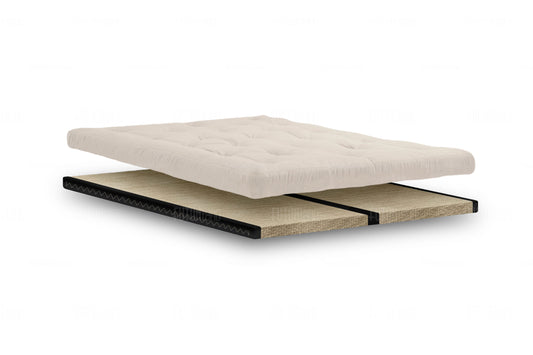
Thick, rigid hardwood slats don't flex—they push back. The mattress stays flat, weight is spread across multiple boards rather than concentrated in the center, and dense natural materials like cotton or wool don't begin extruding into the gaps. Spacing matters too: slats further than 3 inches apart create pressure points that accelerate both mattress wear and slat stress. Closer spacing on rigid hardwood is the combination that actually works.
Building a Setup for Everyday Use
A solid hardwood frame with rigid slats solves the structural problem. The mattress is the other half, and the two need to be matched.
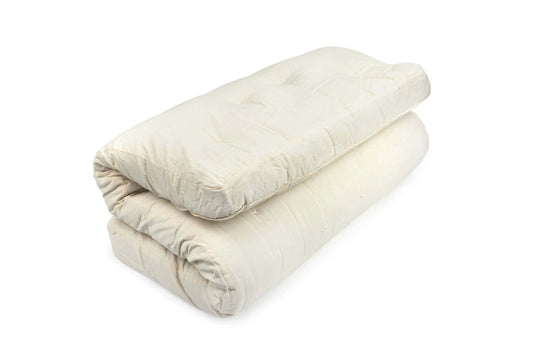
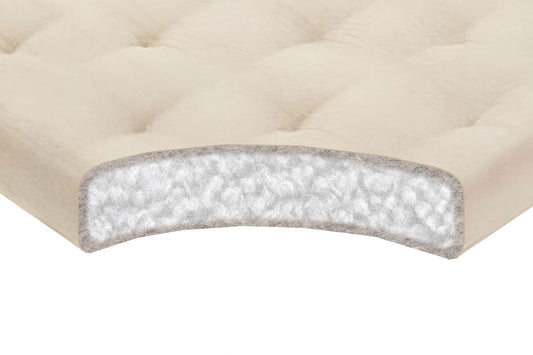
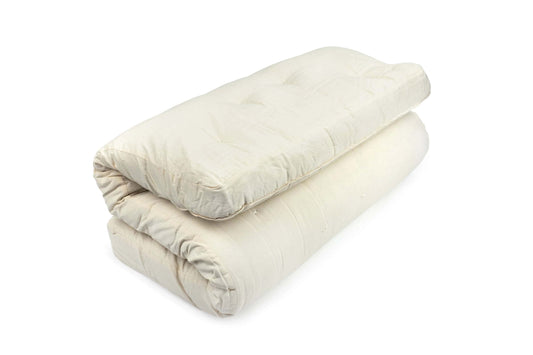
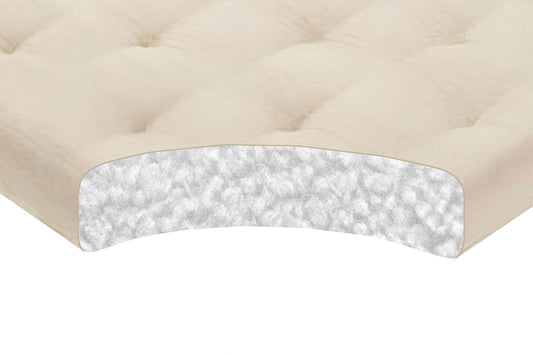
A thin foam mattress on a hardwood frame wastes what the frame can do. Heavy adults and couples sleeping on a futon nightly need a mattress thick enough—at least 8 inches—to provide real support without bottoming out. Dense natural fill holds up better than foam over time: an organic cotton and wool futon mattress compresses under load and rebounds fully, rather than taking a permanent set the way cheaper foam does. Natural latex cores go further—latex deforms under weight and returns to shape completely, and unlike memory foam, it doesn't soften with heat, so it performs consistently regardless of room temperature.
For Airbnb hosts and landlords, this calculus matters more than it might seem. Guest furniture takes abuse that owner furniture doesn't—heavier guests, people sitting on the armrests, kids jumping. A hardwood frame with a quality natural mattress will outlast several cycles of cheap replacements and won't generate the reviews that a broken sofa bed produces.
-
Taurus Futon Sofa Bed
Regular price From $519.99Regular price $699.99 Sale price From $519.99Sale -
Hitachi Tri-Fold Futon Sofa Bed
Regular price From $249.99Regular price $599.99 Sale price From $249.99Sale -
El Paso Futon Sofa Bed
Regular price From $689.99Regular price $819.99 Sale price From $689.99Sale -

 Sale
SaleAries Futon Sofa Bed
Regular price From $569.99Regular price $699.99 Sale price From $569.99Sale -
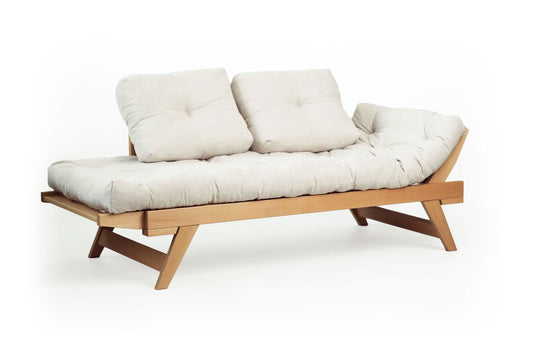
Long Beach Daybed Sofa Bed
Regular price From $659.99Regular price $739.99 Sale price From $659.99Sale -
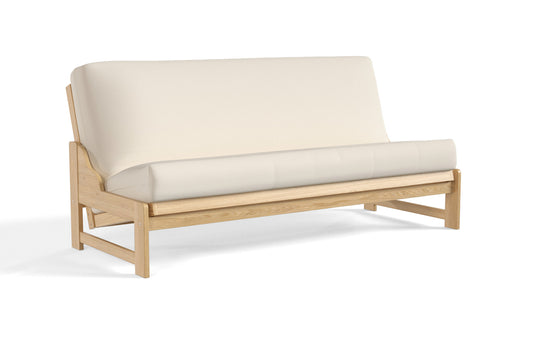
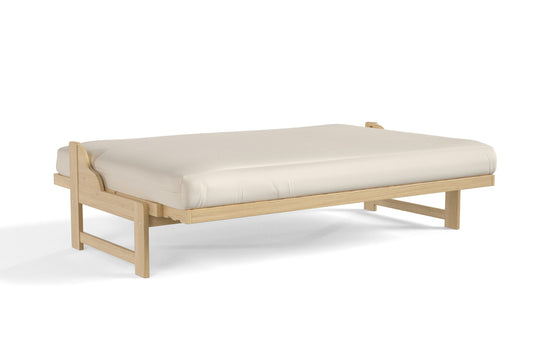 Sale
SaleVirgo Futon Sofa Bed
Regular price From $589.99Regular price $699.99 Sale price From $589.99Sale -
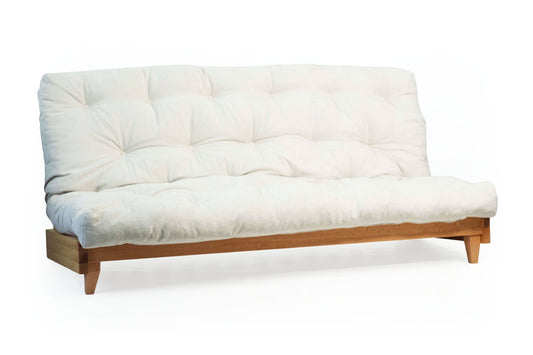
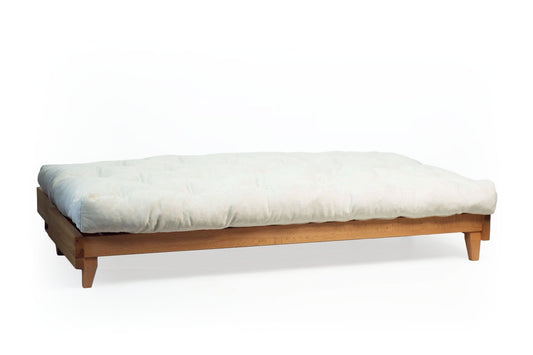 Sale
SaleAkron Futon Sofa Bed
Regular price From $689.99Regular price $819.99 Sale price From $689.99Sale -
Sendai Tri-Fold Futon Sofa Bed
Regular price From $299.99Regular price $349.99 Sale price From $299.99Sale -
 Sale
SaleLibra Futon Sofa Bed
Regular price From $619.99Regular price $699.99 Sale price From $619.99Sale -
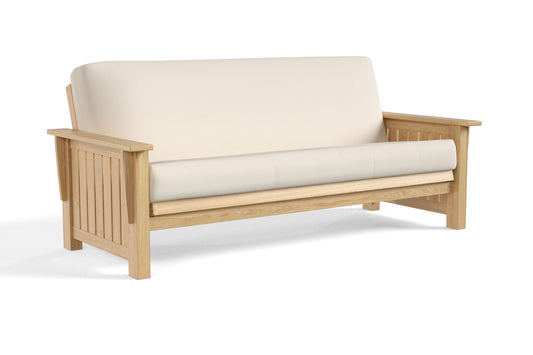
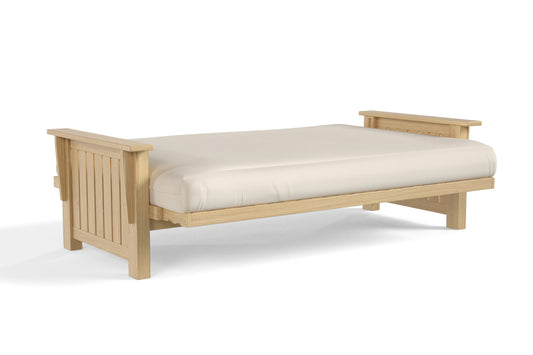
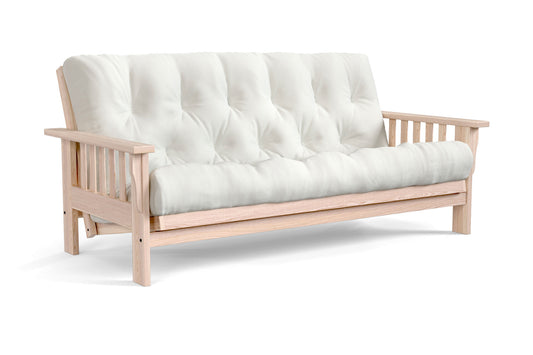
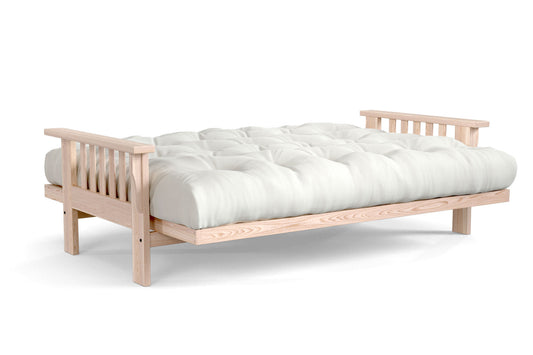
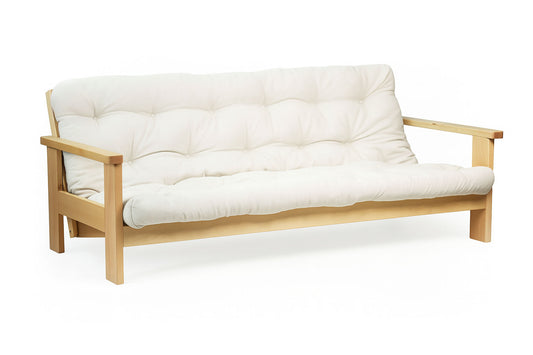
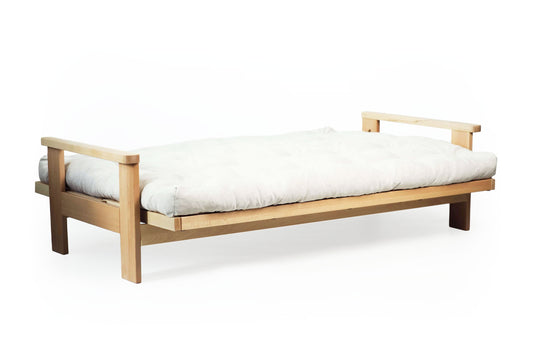
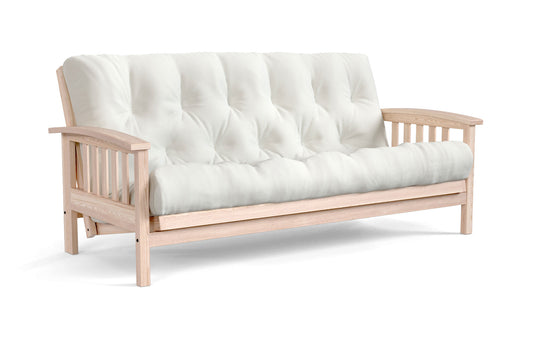
Mission Flat Arm Amish-Made American Oak Futon Sofa Bed
Regular price From $959.99Regular price $1,219.98 Sale price From $959.99Sale -
Elk Grove Futon Sofa Bed
Regular price From $759.99Regular price $869.99 Sale price From $759.99Sale -
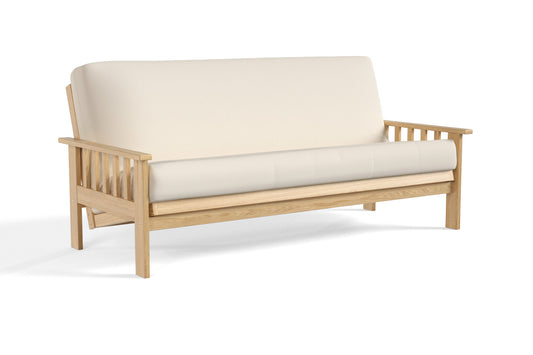
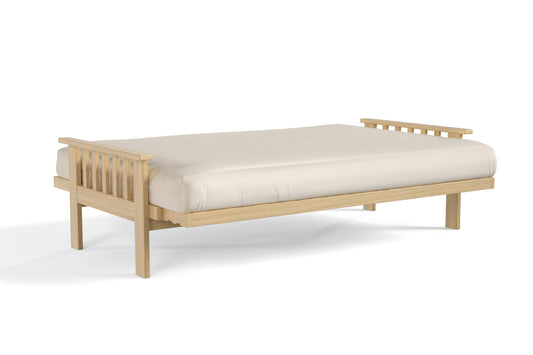
Mission Bent Arm Amish-Made American Oak Futon Sofa Bed
Regular price From $1,019.99Regular price $1,319.98 Sale price From $1,019.99Sale



What to Check Before Buying
Most listings don't volunteer the information you need. Here's what to ask:
What species of wood? "Solid wood" is not a specific answer. Oak, cherry, and maple are hardwoods worth the price. Pine is not. If the listing doesn't specify, assume pine or worse.
What's the joinery method? Mortise-and-tenon or through-bolt joinery are signs of a frame built for load. A frame that ships in five boxes with a bag of bolts is relying entirely on those bolts—that's a warning sign regardless of what wood it's made from.
What are the slat specs? Thickness, material, and spacing. If the listing doesn't include this, ask. A seller who knows their product knows their slat specs.
Is the listed weight capacity static or dynamic? If the seller doesn't know the difference, that tells you something about how the frame was tested.

The Real Cost Comparison
A $300 futon replaced every 18 months costs roughly $200 per year—and that's before accounting for the back pain, the inconvenience of disposal, and the environmental cost of the waste. A solid hardwood frame at $900 that lasts 15 years costs $60 per year. The upfront number is higher. The actual cost over time runs the other way.
That math changes if you genuinely only need a frame for two years in a temporary space. For a guest room used a handful of times a year, a mid-range pine frame might be sufficient. The problem is most people buying a $300 futon aren't in that situation—they're putting it in a living room or using it as a primary bed, and they find out what it's really made of when it breaks.
For a deeper look at wood species and how they perform across different frame styles, see our Wood Bed Frame Guide. Once you've chosen your frame, our guide on How to Choose a Futon Mattress Based on Your Frame and Setup covers how to match the mattress to it properly.
Frequently Asked Questions
What is the weight limit of a solid hardwood futon?
A properly constructed hardwood futon frame with rigid slats and traditional joinery can handle 500 to 600+ pounds of dynamic load—meaning two heavier adults sitting down or sleeping on it nightly, not just weight placed gently across the surface. The exact figure varies by construction, but a well-built hardwood frame should comfortably exceed what any two adults will put on it.
Can a futon be used as an everyday bed for adults?
Yes, with the right setup. The frame needs to be solid hardwood with rigid slats—not pine, not MDF, not hollow metal. The mattress needs to be at least 8 inches thick with dense natural fill (cotton, wool, or latex) to avoid bottoming out under nightly adult weight. Both conditions together make a futon a legitimate primary bed; without either one, the experience degrades noticeably within months.
Why did the slats on my futon break?
Either the slats were thin plywood that couldn't handle the dynamic load, or the spacing between them was too wide—concentrating too much pressure on too few boards. Both are design problems, not use problems. Thick, rigid hardwood slats spaced no more than 3 inches apart eliminate both failure modes.
Is metal or wood better for a futon frame?
Solid hardwood outperforms budget metal frames for heavy everyday use. Hollow metal tubing buckles at weld points under heavy dynamic loads, and once bent, the hinge mechanism is compromised. Solid hardwood with proper joinery distributes that same load through the wood structure itself—a more durable solution for anyone using the futon regularly.